Vai al contenuto



Notebook binding affects much more than how a notebook looks. It determines how easily the pages turn, how well the notebook opens flat, how long it can withstand daily use, and how much the finished product may cost.
For wholesale buyers, promotional product distributors, stationery brands, and companies ordering custom notebooks, choosing the right binding is an important part of product planning. The best option depends on page count, cover material, target price, branding requirements, and how the notebook will be used.
Le-Tian Gifts supports multiple notebook binding styles, including Case Bound, Filo-O, Spirale, Cucitura a sella, A fogli mobili, and Refillable designs. This gives buyers more flexibility when developing notebooks for corporate gifting, promotional campaigns, retail stationery, and custom projects.
What Are the Main Types of Notebook Binding?
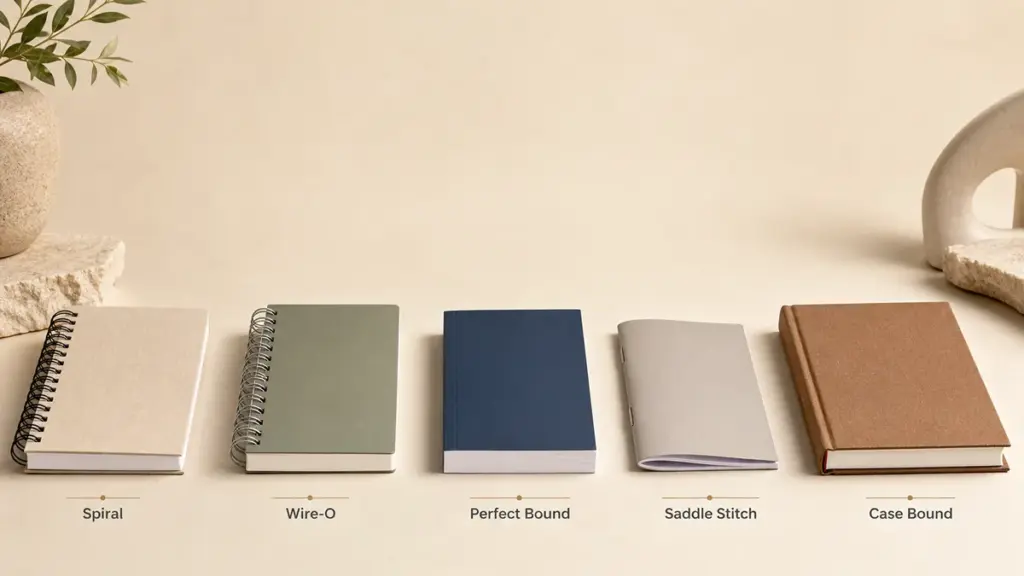
Matching the correct notebook binding to your page count and target market prevents costly product failures and optimizes wholesale manufacturing margins.
The main notebook binding methods include Wire-O, spiral, perfect binding, saddle stitch, sewn binding, and case binding. Each method has different strengths and is suited to different notebook applications.
Wire-O and spiral binding use metal or plastic coils to hold pages together. They are popular for notebooks that need to open flat or fold back on themselves. Perfect binding uses adhesive along the spine and creates a clean, book-like appearance. Saddle stitching uses folded sheets secured with staples and is generally better suited to thinner products.
Sewn binding uses thread to join sections of pages. It provides strong page retention and a premium feel, especially when combined with a hardcover. Case binding, often used for hardcover notebooks, attaches the book block to a rigid cover for a durable and professional finish.
| Binding Type | Main Advantage | Uso tipico |
|---|---|---|
| Filo-O | Flat opening and flexible use | Business notebooks, pianificatori, training books |
| Spirale | Easy page turning and fold-back use | Daily notebooks, school and office use |
| Perfect | Clean book-like appearance | Marketing books, light notebooks |
| Cucitura a sella | Simple and economical | Thin notebooks, event materials |
| Cucito | Strong page retention | Premium journals and long-term use |
| Caso vincolato | High durability and premium appearance | Doni esecutivi, corporate journals |
Spiral and Wire-O Binding for Flexible Daily Use

Spiral and Wire-O mechanical bindings provide flat-lay performance and 360-degree rotation, balancing elasticity and structural alignment for high-use educational and corporate planners.
How do you keep a heavily used planner from falling apart when thrown into a backpack daily? Sourcing decisions for bulk notebook production require a close look at mechanical durability. Choosing between spiral and Wire-O binding dictates how a notebook survives this real-world friction, directly impacting the final user experience and your manufacturing margins.
Mechanisms of Spiral and Wire-O Binding
Mechanical binding relies on physical perforation and precise threading. Spiral binding processes thread a continuous plastic or metal coil helix through a row of round holes punched along the paper margin. Once threaded, automated machinery crimps the coil ends to lock the spiral in place, preventing the filament from unthreading under movement.
Wire-O systems use a different physical dynamic, utilizing pre-formed, double-loop metal wire elements shaped like an open “C”. These loops insert through square or rectangular punched holes before a closing machine crimps the wire into a secure, circular or oval loop. While their insertion methods differ, both options enable a complete 360-degree fold-back rotation and a flat-open writing surface.
Durability and Page Capacity for Daily Handling
Daily abuse tests the structural limits of mechanical binders. Elastic plastic coils excel in high-impact environments like school bags or field kits because the material bends and bounces back to its original shape without crushing.
Conversely, Wire-O uses high-tensile metal that holds pages securely against vertical pulling but can permanently deform when subjected to heavy side-on compression. Once bent, these loops snag and hinder page turns. Capacity limitations require careful matching to the targeted page stack:
- Spiral coils: Accommodate up to 275 sheets (550 pages) with larger coil diameters.
- Wire-O elements: Cap out at roughly 250 sheets (500 pages) to ensure clean crimping and page rotation.
Aesthetic Positioning and Target Market Customization
The look of the spine sets immediate expectations for product tiering. Spiral binding carries a functional, casual connotation. It dominates classrooms, training workshops, and lab environments where utility overrides luxury.
Wire-O delivers a refined, clean aesthetic because the parallel loops keep the left and right pages aligned across the gutter. Corporate buyers, executive planners, and premium retail brands favor this symmetric layout. Customization options allow distinct product positioning:
- Coil color customization: Features vibrant, brand-matched plastic options for custom school or office lines.
- Metallic Wire-O finishes: Employs classic coatings like black, silver, white, and bronze to target executive gifting programs.
Manufacturing Quality Control and Compliance Standards
Consistent page rotation depends heavily on initial punching tolerances. Slight misalignments in the punch line generate physical friction, accelerating wear on the paper around the margins. Reliable manufacturers prioritize tool maintenance to prevent page tearing.
Finishing steps require equal precision: spiral ends need tight, safe crimps to prevent the plastic from catching fabrics, while Wire-O loops require calibrated closing machines to avoid loose loops that release sheets or over-closed loops that crush paper. Physical integrity relies on testing against established regulatory benchmarks:
- ISO 11800: Specifies durability requirements and material specs for book binding.
- ASTM D4279: Governs physical testing protocols for assessing page-pull strength.
- ASTM A853: Regulates the wire tensile strength and steel diameter tolerances used in wire binding.
Custom Corporate Gifts Starting at 100 Unità
Perfect Binding for Clean and Professional Notebook Styles

Perfect binding secures notebook pages using a clean, printable square spine and flexible adhesives, balancing retail-ready aesthetics with structured durability for high-page-count designs.
Are your corporate notebooks losing pages under daily office stress, or failing to make an impact on retail shelves? Opting for perfect binding solves the visual mediocrity of wire coils by delivering a clean, book-like spine that commands attention.
Definition and Structural Characteristics
This binding method replaces mechanical coils with a clean, adhesive-based architecture. It targets brands that prioritize retail presence and structural neatness over industrial utility.
- Flexible Adhesive Bonding: The process binds gathered single sheets directly to a scored softcover spine using high-strength glue.
- Square Spine Profile: This creates a distinctive, book-like spine that stacks neatly and looks professional on retail shelves.
- Limited Opening Angles: Because of the glued spine, these notebooks do not naturally lay completely flat without physical assistance.
While the rigid spine limits hands-free flat writing, the trade-off yields an upscale, bookstore-quality aesthetic that wire-bound alternatives cannot replicate.
Step-by-Step Manufacturing and Adhesive Application
To achieve a durable hold, the manufacturing line follows a precise mechanical sequence. Skipping any of these steps compromises the notebook’s lifespan.
- Spine Preparation: Operators collate the interior sheets into a flush book block, then mill and notch the spine edge to maximize glue penetration.
- Adhesive Selection: Binderies apply a flexible adhesive, relying on polyvinyl acetate (PVA) for standard builds or polyurethane reactive (PUR) for maximum durability.
- Cover Integration: Equipment scores the cover stock on both sides of the spine, wraps it tightly around the tacky adhesive, and performs a clean three-side trim.
Specifying PUR glue costs more upfront, but it prevents the spine from cracking when users repeatedly force the notebook open.
Aesthetic Customization and Brand Styling Levers
For corporate gift programs and premium retail lines, perfect binding acts as a blank canvas. It unlocks branding real estate that mechanical coils destroy.
- Printable Spine: You get a dedicated spine area to print logos, titles, or series numbers, which is impossible on wire-wound books.
- Full-Wrap Graphics: The seamless cover accommodates continuous artwork flowing from the front, across the spine, to the back.
- Premium Finishes: The design supports high-end treatments like soft-touch lamination, metallic foil stamping, and colored page edges.
These features allow you to position the final product as a premium journal rather than a disposable office notepad, justifying higher retail price points.
Technical Specifications and Quality Control Standards
Scaling production without strict quality control leads to warped covers and loose pages. Professional buyers must enforce clear physical benchmarks before approving mass runs.
- Standard Materials: Production standardizes on durable cover stocks, like 13 pt paperboard or polyurethane (PU) pelle, wrapping text blocks of 80 A 200 sheets.
- Grain Alignment: The paper grain of both the covers and the interior pages must run parallel to the spine to prevent buckling and cracking.
- Stress Testing: Quality protocols require tight three-side trim tolerances and repeated openability tests to confirm page retention under manual stress.
Ensuring correct grain direction is the simplest way to prevent the wavy, warped covers that plague low-quality imports.
Case-Bound and Hardcover Options for Premium Projects

Case-bound and hardcover options elevate notebook durability and brand value through rigid board construction, Smyth-sewn signatures, and premium tactile wrap materials.
Selecting the right case-bound and hardcover options determines whether a custom stationery project commands a premium retail price or gets dismissed as low-value corporate filler. Standard softcovers often warp or split under heavy daily handling, making structural assembly and raw material selection the ultimate indicators of product lifespan.
Core Anatomy and Assembly of Case-Bound Notebooks
The longevity of high-end hardbacks relies on structural rigidity and smart load distribution. We build premium books from the inside out to ensure they survive transit, storage, and intensive desk use.
- Rigid Case Construction: A solid core utilizing 1.5 mm to 3 mm grayboard, wrapped tightly with chosen cover materials to protect corner edges from impact.
- Smyth-Sewn Signatures: Folded paper sections stitched together with high-tensile thread, yielding a durable book block that opens comfortably.
- Joint Stability: Heavyweight, high-strength endpapers connect the finished book block directly to the grayboard case, reinforcing the stress-heavy hinge areas.
- Production Lead Time: Commercial casing-in lines require approximately three weeks from initial printing to final cured, wrapped, and boxed delivery.
Cover Materials: Case-Laminated, Cloth, and Specialty Wraps
Tactile feedback drives user perception at the point of sale. Matching the right wrap material to the target audience optimizes manufacturing budgets without sacrificing visual impact.
- Case-Laminated Covers: Coated paper sheets printed with custom graphics, shielded by matte, glossy, or velvet soft-touch protective films.
- Classic Book Cloth: Natural woven linen or cotton fabric paired with foil stamping or debossing, offering a traditional, executive aesthetic.
- Synthetic Leatherette: Faux leather wraps that deliver high-end textures and reliable scratch resistance at a lower raw material cost.
- Specialty Paper-over-Board: Unlaminated textured papers combined with spot UV highlights, heavy embossing, and custom-dyed page edges.
Smyth Sewn vs. Glued Binding: Selecting the Right Block Structure
Deciding between thread-sewn and adhesive blocks impacts both the production budget and the end-user writing experience. Structural integrity is the priority when positioning stationery for professional or retail markets.
- Adhesive vs. Stitching: Smyth-sewn configurations secure paper mechanically, avoiding the spine cracking and page loss common in budget-grade, glued perfect-bound hardcovers.
- Lay-Flat Capability: Thread sewing allows the book to open fully to 180 degrees, keeping pages flat for comfortable daily journaling or sketching.
- Page-Count Thresholds: Rigid cases require structural mass; book blocks require a minimum of 60 interior pages (30 physical sheets) to anchor the spine securely.
- Market Positioning: Smyth sewing targets high-end retail pricing and multi-year archival logging, while glued blocks suit shorter-term, lower-tier projects.
Wholesale Functional Additions and Premium Embellishments
Accessories turn a standard notebook into an integrated workspace. These structural add-ons increase the utility of the product and justify premium wholesale pricing tiers.
- Hardware Enhancements: Woven satin ribbon markers, custom-colored elastic band closures, and expanding elastic pen loops mounted directly to the rear cover board.
- Internal Storage: Fully printed decorative endpapers coupled with expanding gusset pockets made of heavy cardstock on the inside back cover.
- Premium Packaging Options: Retail-ready presentation upgrades such as removable dust jackets, branded paper belly bands, and rigid cardboard slipcases.
- Manufacturing Blueprints: Production-ready specification sheets detailing exact trim sizes, interior paper weights (GSM), and finish tolerances before mass-producing.
How Binding Type Affects Cost, Durabilità, and User Experience

Your notebook’s binding type dictates unit costs, production throughput, and structural durability, ultimately defining the product’s market positioning and user satisfaction.
Binding affects three important factors in a wholesale notebook project: production cost, product life, and daily usability.
A simple saddle-stitched notebook can be economical because its construction requires fewer materials and production steps. Spiral and Wire-O products may cost more depending on the coil or wire, punching process, copertina, and page count.
Sewn and case-bound notebooks usually involve more processing and materials, so their unit cost can be higher. Tuttavia, they can also provide better durability and a more premium appearance.
| Factor | What to Consider |
|---|---|
| Cost | Materiali, labor, page count, copertina, and production complexity |
| Durabilità | How well the spine, pages, and cover withstand repeated use |
| Opening | Whether the notebook opens flat or folds back |
| Appearance | Whether the binding matches a promotional, business, or premium style |
| Branding | Available space and techniques for logos and artwork |
Cost Dynamics and Production Drivers Across Binding Styles
Selecting the right notebook binding type directly determines your manufacturing margins, product lifespan, and how easily end-users can write on each page. Raw material costs and processing complexity dictate the final unit price. Stapled saddle stitching remains the most economical option, while multi-step sewn case binding sits at the top of the pricing tier.
High-volume automation favors inline processes like saddle stitching. Al contrario, labor-intensive hard cases require separate, hands-on steps like board wrapping and casing-in, which slows down the factory floor.
Adhesive choice also changes the financial math. Selecting high-flexibility Polyurethane Reactive (PUR) glue over standard Ethylene Vinyl Acetate (EVA) hot-melt directly increases both machinery throughput and raw material expenditures.
Durabilità, Wear Resistance, and Structural Integrity
Physical durability varies wildly based on how sheets are secured. Sewn signatures in case-bound books offer maximum resistance to page pull-out because they distribute mechanical stress across multiple thread loops.
Perfect-bound books rely entirely on chemical adhesives. Without physical threads, page retention depends solely on glue quality, leaving the spine vulnerable to cracking over typical usage cycles.
Mechanical options like metal spirals and Wire-O bindings eliminate page-pull issues entirely. While they prevent page loss, the metal loops can permanently deform if crushed in a transit box or backpack.
Ergonomics and User Experience: Lay-Flat Performance and Writeability
Usability defines whether a customer keeps using a notebook or abandons it. How the spine behaves under a pen dictates daily comfort.
- Spiral and Wire-O: Deliver optimal 360-degree fold-back capability. This makes them highly efficient for tight work surfaces, clipboards, and mobile note-taking.
- Thread-Sewn Hardcovers: Provide a premium, nearly flat writing surface once broken in, offering seamless writeability without the hand-obstruction issues common to wire coils.
- Standard Perfect Binding: Uses stiff glues that restrict opening angles. Users must apply constant hand pressure to keep the notebook from springing closed.
Strategic Wholesale Selection and Cost-to-Value Tradeoffs
Smart wholesale buyers align binding specifications directly with the target audience. Specifying expensive case binding for a disposable, short-term promotional campaign wastes budget on durability that will never be used.
For the education and office sectors, mid-tier spiral and PUR perfect binding hit the sweet spot. These methods balance long-term daily wear with strict corporate budget boundaries.
Premium retail brands must take a different path. Utilizing high-spec Wire-O or sewn case bindings justifies elevated retail prices and immediately reinforces high-end brand positioning.
Choosing the Right Notebook Binding for Wholesale and Custom Orders

Selecting the correct notebook binding dictates your manufacturing margins, product lifespan, and user satisfaction, directly impacting the commercial success of wholesale and custom stationery runs.
| Binding Type | Relative Cost | Durabilità | Flat-Lay Behavior | Primary Target Market |
|---|---|---|---|---|
| Cucitura a sella | Very Low | Low to Medium | Good (under 48 pages) | Budget exercise books, promotional booklets |
| Spirale (Bobina) | Low to Medium | Medium to High | Excellent 360° rotation | School notebooks, manuals, training workbooks |
| Filo-O | Medium | Medium to High | Excellent flat lay & 360° | Corporate planners, executive notebooks |
| Rilegatura perfetta | Medium | Medium | Resists flat opening | Softcover journals, retail paperbacks |
| Rilegato con custodia (Cucito) | Alto | Very High | Good with sewn blocks | Riviste premium, archival books, gifts |
Analysis of Primary Notebook Binding Types
When planning a bulk stationery run, selecting the wrong notebook binding will trigger immediate product returns and erode your margins. Wholesalers must evaluate mechanical, adhesive, and sewn structures to ensure the finished product matches its intended physical performance.
Mechanical bindings like spiral coils, wire-o, and plastic combs provide varied degrees of layout flexibility. Plastic spiral coils resist crushing under rough handling and spring back to shape. Al contrario, double-loop metal wire-o binds pages in perfect alignment, offering a highly structured profile. Plastic combs permit easy page updates, but they lack the professional look needed for retail shelves and do not allow full 360-degree rotation.
Specialty configurations require other structural formats. Tape binding relies on adhesive covered by paper or fabric tape, serving as a clean, low-cost option. Screw and post binding bolts the page block together, offering robust and customizable page capacity. Stitched formats, such as Japanese stab binding, use decorative visible thread, which limits page opening but appeals to artistic stationery brands.
Thicker journals call for softcover perfect binding or rigid casebound methods. Perfect binding wraps a scored cover around a block milled and glued with polyurethane reactive (PUR) adhesive, yielding a squared, printable spine. Premium brands choose casebound hardcover methods, joining sewn signature blocks to thick grayboard wrapped in cloth or faux leather. This provides ultimate page protection and maximum durability.
Matching Binding Methods to Target Market Applications
Successful wholesale operations align binding choices with the target buyer’s work environment. Sourcing high-end bindings on low-cost school books wastes capital, while cheap staples on corporate journals ruins brand equity.
Academic and daily office settings require high-utility mechanical options. Students and workshop attendees need spiral coil and wire-o planners. These bindings permit full 360-degree foldback, letting users write comfortably on small lecture hall desks or while standing. Wire-o satisfies corporate clients who demand a polished meeting-room presentation along with flat-lay usability.
Budget-sensitive marketing campaigns require different formats. Saddle stitching and simple tape binding work best for high-volume, low-margin promotional giveaways. Saddle stitching nests folded sheets together and staples them through the spine crease. This automated process minimizes material costs and enables fast turnaround times on large runs.
High-end boutique stationery and executive gift markets demand craftsmanship. Wholesalers serving these tiers rely on casebound methods and Smyth-sewn signature blocks. Smyth sewing weaves thread through folded signatures before casing-in. This delivers a premium finish, keeps pages secure under heavy writing, and ensures the book opens flat on a desk.
Key Technical and Commercial Selection Criteria
Product performance rests on balancing mechanical specs against production reality. Wholesalers must calculate three primary variables before committing to a factory run.
- Page count and paper thickness: Thin books under 48 pages work well with low-cost saddle stitching. Exceeding 64 pages with thick paper causes page creep and spine distortion, forcing a shift to perfect binding or spiral coils.
- Usability and lay-flat needs: Handheld logs, diaries, and field workbooks require 180-degree lay-flat behavior. Spiral and thread-sewn bindings keep hands-free writing effortless, while standard glued perfect binding springs shut without manual force.
- Commercial scaling and setup fees: Saddle stitching and perfect binding lines run at extremely high speeds, dropping unit costs on big orders. Casebinding demands specialized board-wrapping and casing-in machinery, which increases processing time and tooling costs.
Quality Control Practices and Industry Durability Standards
Preventing batch failures requires strict manufacturing controls. Check physical samples before shipping to guarantee that your custom production run meets customer expectations.
In-process checks must verify paper grain direction first. Folding sheets against the grain weakens the paper fibers, causing cracked spine folds and stiff page turning. Factories must continuously monitor punching die alignment for spiral coils to prevent misaligned holes that catch and tear sheets during daily use.
Post-production testing evaluates physical integrity. Quality teams utilize page-pull tests to measure the force required to rip a sheet from a glued spine. Flex tests simulate years of heavy use by rapidly flexing the notebook covers, identifying brittle hot-melt EVA or thin PUR coverage before the product reaches retail distribution channels.
Wholesalers targeting educational systems, università, and government agencies should require compliance with library binding standards. Sourcing books built to ISO 14416:2003 or ANSI/NISO/LBI Z39.78-2000 ensures maximum paper durability, strong joints, and high thread quality, assuring buyers that the notebooks survive archival storage and active use.
Customization Potential and Structural Constraints
Every binding format imposes clear design limitations. Understanding these boundaries prevents production delays and aesthetic disappointment when designing customized notebook lines.
Spine print visibility varies widely. Perfect-bound and casebound notebooks feature a flat, square spine suitable for titles, logos, and volume numbers. Spiral and wire-o notebooks expose the bare coil, restricting brand graphics entirely to the front and back cover faces.
Integrating functional inserts requires matching layout design to binding strength. Spirale, wire-o, and disc systems accommodate heavy interior stocks, tabbed section dividers, perforated sheets, and pocket sleeves without pulling the spine out of alignment. Adhesive perfect-bound blocks struggle with heavy inner inserts, as rigid additions pull against the glue line and risk splitting the spine.
Finally, mechanical machinery dictates final product thickness. Coated wire-o combs typically cap thickness at 1.125 pollici, and perfect binders handle blocks up to 2 pollici. Aligning your custom designs with standard trade sizes ensures smooth processing on automated industrial finishing lines.
Common Binding Problems Buyers Should Check Before Ordering

One common issue is misaligned holes or wire, which can make pages difficult to turn. With glued binding, weak adhesive or poor spine preparation can lead to pages coming loose. For sewn notebooks, uneven stitching can affect both appearance and strength.
Buyers should inspect several areas during the sample approval stage:
- Spine strength: Open and close the notebook repeatedly to check whether the binding remains secure.
- Page alignment: Check whether pages, covers, and punched holes line up correctly.
- Opening performance: Confirm whether the notebook opens as expected and whether it stays reasonably flat.
- Cover attachment: Check for lifting, wrinkles, loose edges, or uneven wrapping.
- Page retention: Turn pages repeatedly and check for loose sheets.
- Branding quality: Inspect whether the logo position and finish remain consistent around the binding area.
It is also worth checking how the notebook behaves after repeated use. A binding can look good when new but still perform poorly if the spine becomes loose after frequent opening and closing.
For large wholesale orders, approving a pre-production sample is therefore an important quality-control step.
Why Work With Le-Tian Gifts for Custom Notebook Binding?
For a custom notebook project, binding is only one part of the final product. Paper selection, cover construction, stampa, branding, accessories, confezione, and quality control all need to work together.
Le-Tian Gifts combines notebook manufacturing with its wider experience in custom pens and corporate gift solutions. This is particularly useful for buyers who want to develop a notebook together with a branded pen instead of managing multiple suppliers.
Key advantages include:
- Multiple notebook structures: Different binding and notebook formats can be selected according to the project’s application and target price.
- Flexible customization: Covers, pagine interne, finishes, accessories, and branding can be developed around specific requirements.
- Custom pen and notebook solutions: Buyers can develop coordinated products for regali aziendali, promotional campaigns, eventi, and employee programs.
- Factory-direct production: A single manufacturing partner can simplify communication from product development through production.
- Sustainable notebook options: Buyers can explore recycled materials, FSC-related paper options, and other environmentally focused materials where required.
- Pre-production sampling: Samples allow buyers to check the actual binding, paper, copertina, and branding before moving to bulk production.
Planning a custom notebook or notebook-and-pen gift set? Contact Le-Tian Gifts to discuss your binding, materiali, branding, and wholesale requirements and request a tailored quotation.
Domande frequenti
What are the main types of notebook binding?
The main types include Wire-O, spiral, perfect binding, saddle stitch, sewn binding, and case binding. Loose-leaf and refillable systems are also common for notebooks designed for long-term organization. The right option depends on page count, durabilità, opening style, bilancio, and intended use.
What is the difference between spiral and Wire-O binding?
Both use punched holes along the notebook edge, but their structures are different. Spiral binding uses a continuous coil, while Wire-O uses separate metal loops. Spiral binding is highly flexible and can fold back easily, while Wire-O usually provides a cleaner and more structured appearance.
Which notebook binding is most durable?
For premium notebooks designed for long-term use, sewn and case-bound construction are generally among the most durable choices. Durability also depends on paper weight, cover construction, adhesive or thread quality, and overall manufacturing quality.
Is perfect binding suitable for high-volume notebook lines?
Perfect binding is an excellent, cost-effective choice for medium to thick retail journals and planners, particularly those with 90 A 300 pages. It creates a square, flat spine that accommodates printed titles and logos, which looks highly professional on store shelves. The primary limitation is that standard perfect-bound notebooks do not lie completely flat on a desk, so they are less practical for hands-free writing or extensive writing near the inner margins.
What is the best binding style for custom corporate branding?
The ideal binding matches the marketing objective and recipient tier. For high-volume event giveaways, saddle stitching or plastic spirals keep unit costs low while offering practical writing utility. For premium corporate gifts, inserimento esecutivo, and retail-ready stationery lines, hardcover case-bound or softcover perfect-bound options are superior because they support flat-spine branding, custom endpapers, stampa a foglio, and debossing.
How does the selected binding type impact wholesale purchasing costs?
Binding affects pricing through materials, labor, production time, page preparation, and equipment requirements. Simple structures such as saddle stitch can be economical, while sewn and case-bound notebooks usually require more processing. For an accurate wholesale quotation, binding should be evaluated together with page count, paper, copertina, size, quantity, and customization requirements.