A buyer ordering 5,000 straight-barrel pens for a trade show needs a logo that stays readable from across the aisle. That requirement, more than anything else, is what selects custom pens for screen printing. The method lays down a thick, opaque ink film that survives handling and reads clearly at distance—exactly what bulk promotional orders need.
This guide explains how screen printing works on pens, which barrel shapes it suits, where it loses to pad printing, and what to confirm with a supplier before you commit a bulk order. One detail worth knowing up front: because setup is charged per color, the structure of your artwork decides cost as much as quantity does. Every production claim reflects the checks Le-tian Gifts runs on its own screen printing lines.
Key Takeaways
- Screen printing pushes ink through a mesh screen, laying a thick, high-opacity film ideal for bold logos.
- It performs best on straight, cylindrical barrels printed one or two colors at volume.
- One screen per color: each added color adds setup cost and registration work.
- Pad printing wins on curved, tapered, or fine-detail work; screen printing wins on solid coverage.
- Le-tian Gifts runs ink stability testing in its QC center; metal parts face 48-hour salt spray testing.
- Orders start at 100 इकाइयां (MOQ); sampling 5–10 दिन, mass production 14–25 दिन.
What Is Screen Printing?
Screen printing is a stencil printing process that pushes ink through a fine mesh screen onto the pen surface, depositing a thick, opaque ink film. A stencil blocks the mesh everywhere except your logo, so ink passes only where the artwork sits—one color, one screen.
Few decoration methods have this track record: ले-तियान उपहार’ pen-making heritage reaches back to the mid-1990s, and screen printing is still the workhorse among the common pen printing methods for bold, single-color logos at volume. The one variable that decides quality before ink ever flows is mesh count—a coarse mesh lays down heavy ink for bold marks, a fine mesh holds finer detail but gives up coverage, so screens get chosen per logo, not per order.
How Screen Printing Works on Pens
The production flow has four stages, and each one is a checkpoint where quality is either locked in or lost:
- Screen preparation. Your logo is output to film and exposed onto a mesh screen coated with light-sensitive emulsion; one screen per color.
- Registration. For multi-color logos, the screens are aligned on the machine so each color lands in position, color after color.
- Printing. The barrel rotates beneath the screen as the squeegee passes, forcing ink through the open mesh in a single stroke.
- Curing. The wet imprint passes through drying—air, गर्मी, or UV—so the film bonds to the barrel before packing.
Curing is the step that decides durability. An under-cured screen print looks perfect at the factory and scratches off in a coat pocket two weeks later, which is why curing time and temperature are locked per ink-and-barrel combination, and why Le-tian Gifts runs ink stability testing before production starts.
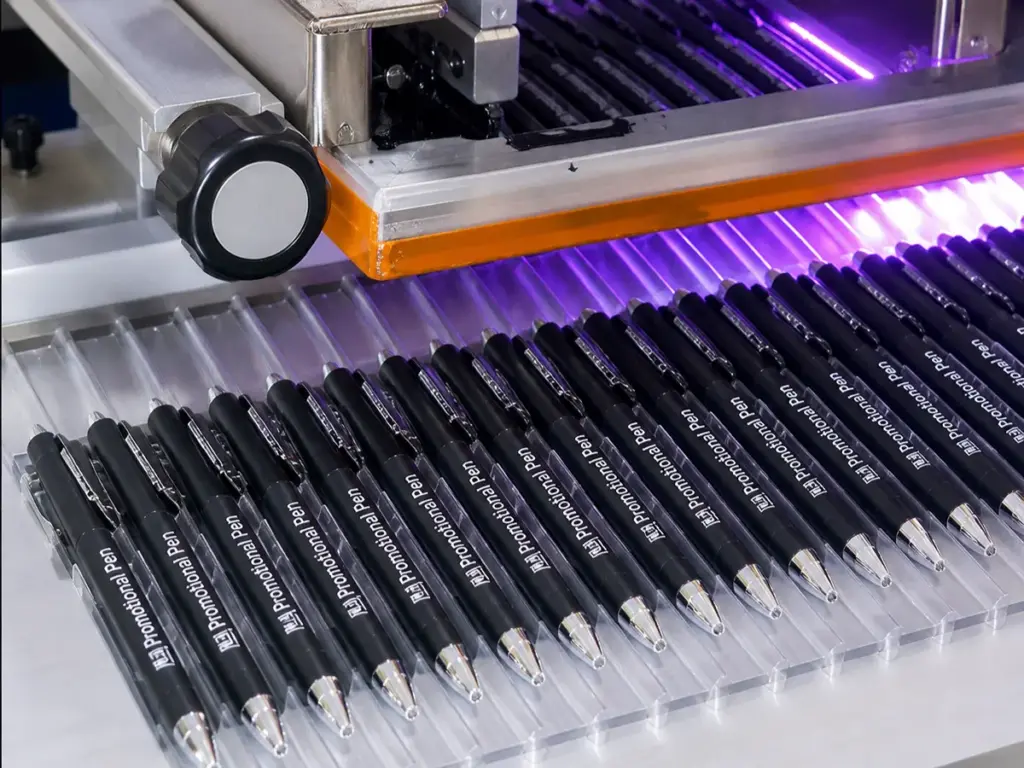
Curing in practice: imprints leave the line fully bonded before packing, not half-dry.
Screen printing also changes what artwork you submit. Logos should arrive as vector files (AI, EPS, or PDF) with a Pantone code for each color, and minimum line weights should be agreed with the factory before screens are exposed—hairlines that look crisp on screen can fall apart through the mesh. A bitmap logo lifted from a website prints with jagged edges; a quick redraw before production prevents a full reprint later.
Which Pens Are Suitable for Screen Printing?
Straight, cylindrical barrels are the natural home of screen printing—the print head wraps cleanly around a constant radius. Barrel diameter matters more than material here, because the screen must match the curvature to keep the logo undistorted.
- Straight plastic barrels. The classic case: uniform diameter, one or two colors, tens of thousands of units.
- Metal barrels. Take the thick ink film well after full cure; salt spray testing on metal parts protects the investment.
- Slightly tapered barrels. Printable with a matched screen, but the logo must be sized for the narrow end or it distorts.
- Deep curves and clips. Where the surface bends away from the screen, print quality drops—these areas belong to pad printing.
The material decision interacts with branding more than buyers expect; the custom pen cost breakdown shows how barrel choice moves unit price alongside decoration.
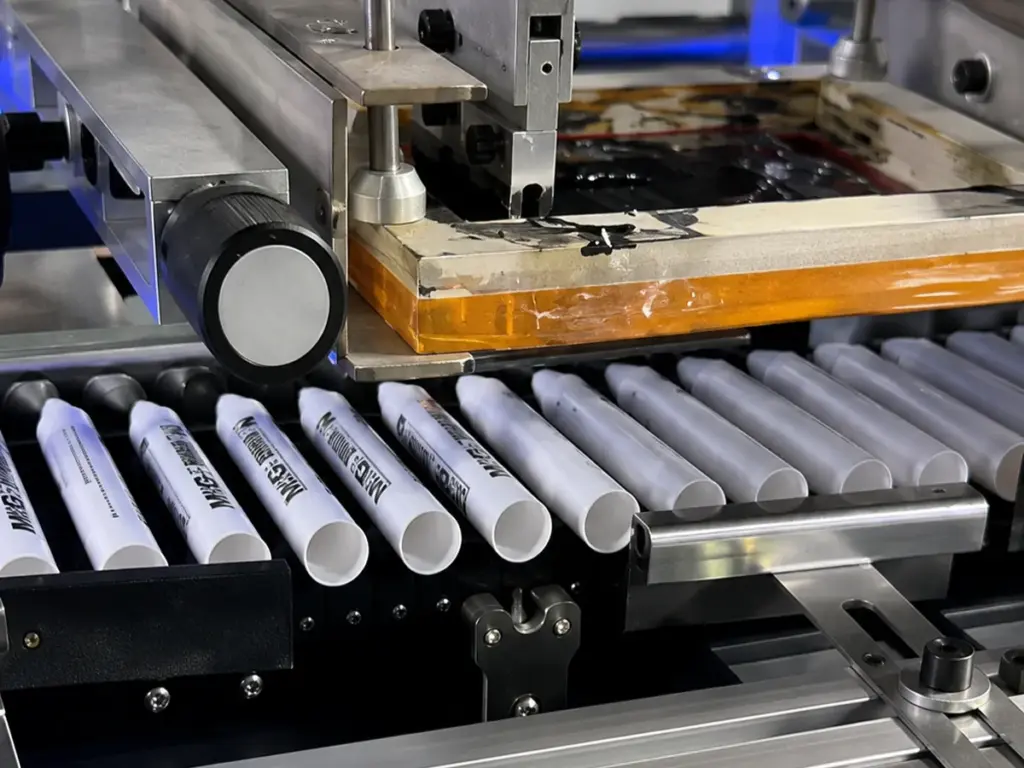
Automated screen printing on straight white barrels—the constant-radius geometry this method prefers.
Advantages of Screen Printing for Custom Pens
Four practical advantages explain why bulk buyers keep choosing it:
- Opaque, bold coverage. The thick film lays solid color over dark barrels—white on black reads perfectly, which thin-film methods struggle to match.
- Low unit cost at volume. Once screens are set, the stroke repeats in seconds, so five-figure runs stay cheap per unit.
- Strong color density. Spot inks print rich and uniform, matching Pantone references across re-orders from the same screen.
- Simple, proven workflow. The process is easy to inspect: print, cure, rub-test, pack—failures surface before shipment.
For a procurement team, the combination that matters is opacity plus price. A bold one-color logo on a dark barrel is the single most common promotional pen brief, and screen printing executes it at the lowest decoration cost among the common methods.
Limitations of Screen Printing
Know the boundaries before artwork is submitted—each of these limits costs money to discover after screens are made:
- One screen per color. A four-color logo needs four screens, four registrations, and four times the setup; beyond two or three colors, economics collapse.
- Curved and tapered surfaces. The screen cannot follow a deep curve—wraps blur and thin out as the radius departs from the screen curve.
- Fine detail ceiling. Hairline text and intricate marks lose edge sharpness through the mesh; fine work belongs on a pad printer.
- No gradients or photographic art. Full-color designs need heat transfer or digital printing instead.
The failure pattern to avoid is familiar: artwork arrives with a small tagline under the logo, the tagline prints soft through the mesh, and the whole run is reprinted at the supplier’s cost and the buyer’s deadline. Confirm minimum line weights with the factory before screens are exposed.
Planning a Bulk Screen-Printed Pen Order?
Le-tian Gifts screen prints custom pens from 100 इकाइयां, with free design mockups and quotes returned within 6 hours.
MOQ 100 | Free mockup| Ink stability tested
Explore Our Products →Screen Printing vs Pad Printing
Screen printing pushes ink through a mesh onto the barrel; pad printing lifts ink from an etched plate with a silicone pad. The two methods overlap on simple cylindrical work, and the honest answer is that either can produce a good pen—the choice is about geometry and logo structure, not quality.
| Aspect | स्क्रीन प्रिंटिंग | पैड प्रिंटिंग |
|---|---|---|
| बैरल आकार | Straight cylinders print best | Curved, tapered, and irregular shapes |
| Logo coverage | Large, solid, bold marks | Small to mid-size marks |
| Color count | 1–3 colors practical | 1–4 spot colors, one plate each |
| Fine detail | Good; loses hairlines through mesh | Excellent: fine text and thin lines |
| Opacity on dark barrels | Excellent thick film | Good with matched ink series |
| Setup for re-orders | Screens stored and re-run | Clichés stored and re-run |
The verdict: for a straight barrel carrying a bold one-color logo at volume, screen printing delivers the boldest, most opaque imprint at the lowest unit cost—choose it. The moment the barrel curves, tapers, or the logo shrinks to fine text, switch to pad printing, where the silicone pad follows surfaces a screen cannot touch.
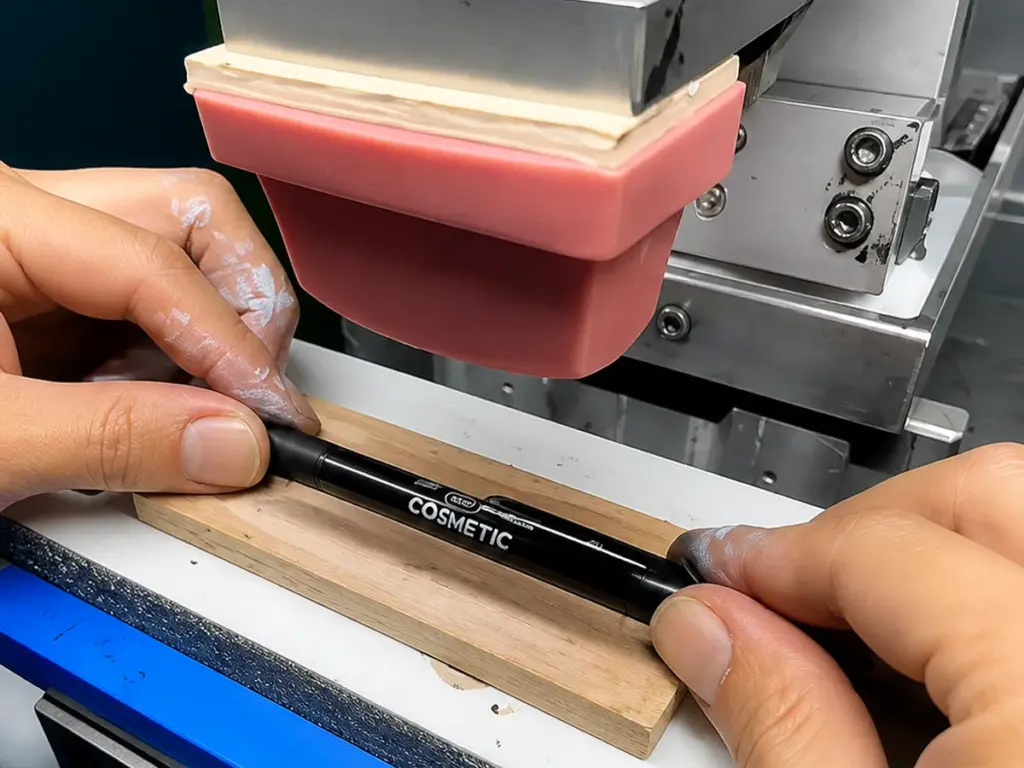
Pad printing station handling a curved barrel—the geometry that pushes work off the screen line.
Screen Printing Applications for Promotional Pens
- Trade shows and exhibitions. Thousands of units, one bold logo, hard deadline—the profile screen printing was built for.
- Hotel, restaurant, and bank pens. Straight stick pens printed one color, ordered on repeat from stored screens.
- Healthcare and insurance giveaways. Compliance teams like the fidelity of spot color to a fixed Pantone code.
- School and event merchandising. Tight budgets per unit, where the thick one-color print keeps the brand visible to the last pen.
For buyers folding printed pens into a wider custom program, the OEM and ODM services team takes artwork through mass production as one managed project. Send artwork and quantity to the team at ले-तियान उपहार and compare screen and pad printing options on your actual barrel model before committing.
How Le-tian Delivers High-Quality Screen Printed Pens
Quality on a screen printing line is locked in at checkpoints, not inspected at the end. Ink stability is tested before a production run starts, curing parameters are locked per ink-and-barrel combination, and finished pens go through durability checks, including 48-hour salt spray testing on metal components, before packing. A run that fails at any checkpoint stops there; it does not ship and turn into a dispute later.
Those checks run on real capacity. Production sits at the Wengang, Jiangxi facility—China’s pen capital—on ten automated and semi-automated lines with annual output near 10 million pens. Le-tian Gifts supplies programs for Fortune 500 brands including Google, DHL, BMW, and Samsung, so the lines that run five-figure promotional orders also run your 100-unit trial batch.
Documentation is part of the deliverable. Product certificates cover SGS, एमएसडीएस, and EBO, and the factory is audited to RoHS, बीएससीआई, and TÜV Rheinland standards. If your compliance team needs paperwork for retail, healthcare, or government programs, ask for it with the quote—not after the purchase order, when the production calendar is already locked.
Commercial terms stay predictable: quotes returned within 6 hours, sampling in 5–10 days after artwork approval, mass production in 14–25 दिन, minimum order 100 इकाइयां.
अक्सर पूछे जाने वाले प्रश्नों
What is screen printing on pens?
Screen printing pushes ink through a mesh screen stencil onto the pen barrel, laying a thick, opaque imprint. It is the standard method for bold logos on straight promotional pens.
How many colors can screen printing apply on a pen?
One to three colors is the practical range. Each color needs its own screen and registration pass, so cost rises with every added color.
Screen printing or pad printing—which is better?
Screen printing for straight barrels and large solid logos; pad printing for curved barrels and fine detail. Match the method to the geometry, not to a quality ranking.
Is screen printing durable on pens?
हाँ, once fully cured the film resists daily handling. Le-tian Gifts runs ink stability testing and durability checks, including 48-hour salt spray testing on metal parts.
What MOQ and lead time apply to screen-printed pens?
Orders start at 100 इकाइयां. Sampling takes 5–10 days after artwork approval, and mass production runs 14–25 days depending on the model.
Can screen printing match my brand colors?
हाँ. Spot inks are mixed to Pantone references, and the thick film holds color density on dark barrels better than thin-film methods.