सामग्री पर जाएं


Custom pens are one of the most practical promotional products for businesses, schools, घटनाएँ, hotels, retailers, और corporate gift programs. However, the quality of a custom pen depends on more than the pen itself. The pen printing method affects how the logo looks, how long it lasts, what colors can be used, and which pen materials are suitable.
Different printing technologies work better on different pen shapes and surfaces. A method that works well on a smooth plastic barrel may not be the best choice for a metal pen or a detailed full-color logo.
This guide explains the main custom pen printing methods, their strengths and limitations, and how to choose the right option for your project.
What Are the Main Pen Printing Methods?
The most common methods used for custom pen branding include pad printing, screen printing, UV digital printing, laser engraving, and sublimation or heat transfer.
Each method uses a different process to transfer a logo, text, image, or artwork onto the pen surface.
| Printing Method | Definition & Working Principle | Best For (Pen Type) | Color Options | Pros & Cons |
|---|---|---|---|---|
| Pad Printing | Uses a silicone pad to transfer ink from an etched plate onto curved or uneven surfaces. | प्लास्टिक पेन, curved barrels, small promotional pens | 1–4 spot colors | ✔ Good for curved surfaces ✔ Cost-effective for bulk orders ✖ Limited detail & color complexity |
| Screen Printing | Ink is pushed through a mesh screen stencil onto the pen surface. | Smooth barrel pens, straight plastic pens | Solid spot colors | ✔ Strong, bold branding ✔ Durable ink layer ✖ Not suitable for gradients or fine details |
| UV Digital Printing | Inkjet printing directly applies ink and cures it instantly using UV light. | Plastic, coated pens, detailed artwork pens | Full color (CMYK + white) | ✔ High detail & photo-quality ✔ Supports gradients ✖ Higher cost than basic printing |
| Laser Engraving | A laser beam removes or alters the surface layer to create a permanent mark. | धातु कलम, premium pens, coated metal barrels | Single-tone (material color contrast) | ✔ Extremely durable ✔ Premium appearance ✖ No color printing, only engraving effect |
| Sublimation / Heat Transfer | Heat transfers dye into a coated surface, embedding the design into the material. | Coated pens, special surface-treated pens | Full color | ✔ Rich color output ✔ Good for wrap designs ✖ Limited to compatible coatings/materials |
Pad Printing (Tampo Printing)
This process relies on a flexible silicone pad to transfer ink from an etched plate onto curved, irregular, or textured pen barrels and clips.
- Industry Role: Serves as the primary standard for high-volume plastic promotional pens due to its speed and precise small-detail registration.
- Color Capacity: Typically accommodates one to four spot colors.
- Setup Requirements: Demands separate plates and print passes for each individual color.
Screen Printing (Silk Screen Printing)
Screen printing applies ink directly through a wrapped mesh screen to create large, bold, and highly opaque designs around the pen barrel.
- Vibrant Saturation: Provides excellent durability and vibrant color saturation, especially when printing light inks on dark pen bodies.
- Production Fit: Highly cost-effective for large production runs but less practical for short batches due to screen setup and physical alignment.
Digital and UV Inkjet Printing
This method jets microscopic droplets of UV-curable ink directly onto smooth pen surfaces, using integrated LED lamps for instant curing.
- No Tooling: Eliminates traditional setup plates, enabling cost-effective short runs, rapid prototyping, and variable data personalization like individual names.
- Graphic Options: Delivers high-resolution, full-color gradients, photographic imagery, and optional tactile varnish finishes.
Laser Engraving for Metal Substrates
Laser engraving uses a computer-controlled laser beam to vaporize the surface finish, creating a permanent, wear-resistant mark that will not chip or peel.
- Monochrome Finish: Produces a precise, upscale look where the final logo color depends entirely on the exposed underlying base metal.
- Eco-Friendly Process: Eliminates inks and solvents from the production line, offering a clean decoration method for premium or executive pens.
Specialty Customization (Foil, Heat Transfer, and Decals)
For unique branding demands, special techniques bypass the limits of standard ink-on-metal or ink-on-plastic prints.
- Foil Hot-Stamping: Uses heat and pressure to transfer metallic films, giving simple logos an opaque, luxury gold or silver finish.
- Heat-Transfer & Sublimation: Applies full-wrap, high-impact artwork around the entire barrel using pre-printed carrier films.
- Adhesive Labels & Domed Decals: Offers flexible manual solutions for multi-surface compatibility and complex 3D effects on small runs.
Evaluating these decoration options against your budget, volume, and artwork design allows you to secure the most effective production path for your custom writing instruments.
Pad Printing for Curved Plastic Pen Barrels
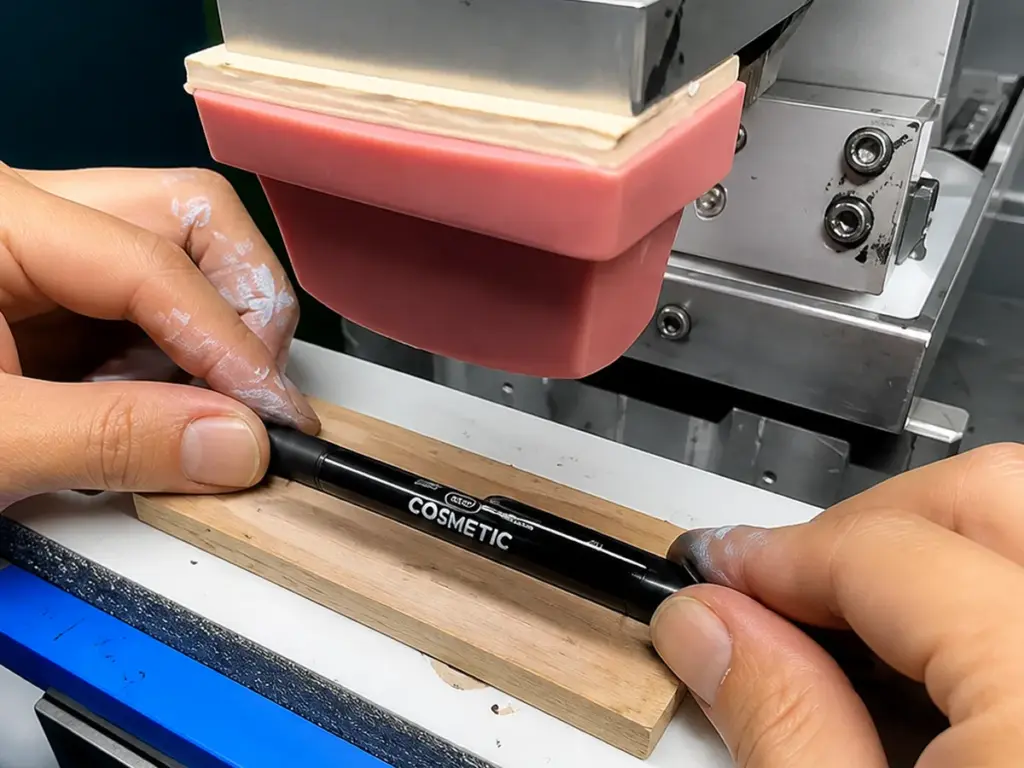
Pad printing is one of the most widely used methods for promotional pens. It is especially useful when the printing area is small or slightly curved.
Mechanics of Printing on Curved Surfaces
Standard flat printing methods fail on cylindrical substrates because they cannot maintain consistent contact. Pad printing relies on the physical adaptability of silicone to bridge this gap.
- Silicone pad flexibility: Allows the ink film to transfer smoothly onto cylindrical and irregular pen barrels.
- Pad deformation: Wraps around the curvature during the press cycle, typically limiting clean print coverage to 25% को 30% of the pen barrel circumference.
- Tack gradient formation: Solvents evaporating during the transition from cliché to pad create a sticky outer layer, ensuring a complete ink release onto the plastic substrate.
Pad Selection and Cliché Engineering
Executing a clean transfer requires matching the pad shape to the barrel’s contour while configuring the etching plates for high-speed throughput.
- Silicone durometer: Softer silicone pads facilitate wrapping around cylindrical shapes but raise the risk of pinholing and static attraction.
- Contoured geometries: Contoured, roof-shaped, or hollow pads reduce air trapping and minimize image distortion on curved faces.
- Cliché engineering: Narrow, elongated clichés allow multi-up layouts to print several pen barrels simultaneously in a single cycle.
Fixture Design and Part Handling
If the pen rolls or flexes under down-stroke pressure, the image smears instantly. Rigid fixturing provides the mechanical stability required for rapid stamping cycles.
- Nesting fixtures: Support rigid barrels in precisely shaped channels to prevent shifting or rolling during contact.
- Mandrel fixtures: Provide internal structural support for thin-walled plastic pens to prevent collapse under pad pressure.
- Rotational orientation: Automatic feeding lines utilize rotational orientation systems to align the imprint consistently with the pen clip.
Ink Systems and Substrate Pre-Treatment
Adhesion on polymers depends entirely on surface energy. Selecting the proper ink chemistry and preparing the substrate dictates the print’s overall lifespan.
- Polypropylene treatment: Polypropylene pen barrels require flame or corona pre-treatment to raise surface energy and ensure ink bonding.
- पेट & Polycarbonate: These barrels accept standard solvent-based inks, often mixed with hardeners to increase resistance to hand oils.
- Curing profiles: Thermal curing profiles must be carefully managed to dry the ink rapidly without deforming low-temperature plastics.
Print Limitations and Common Defects
Maintaining a high yield rate requires continuous monitoring of pad compression and fixture alignment to combat predictable process failures.
- Image distortion: Stretching and distortion occur when attempting to print beyond the mechanical wrap limits of the cylindrical surface.
- Pinholing: Caused by dust contamination, static electricity on plastic, or over-compression of soft silicone pads.
- Misregistration: In multi-color systems, misalignment stems from fixture wear or imperfect cliché alignment across sequential printing pads.
Balancing pad durometer, mechanical fixturing, and surface prep ensures high-yield production. By managing the physical limits of pad wrapping and matching ink systems to specific polymers, manufacturers achieve durable, legible branding on curved pen barrels.
Custom Corporate Gifts with 100-Unit MOQ
Screen Printing for Bold Single-Color Pen Branding
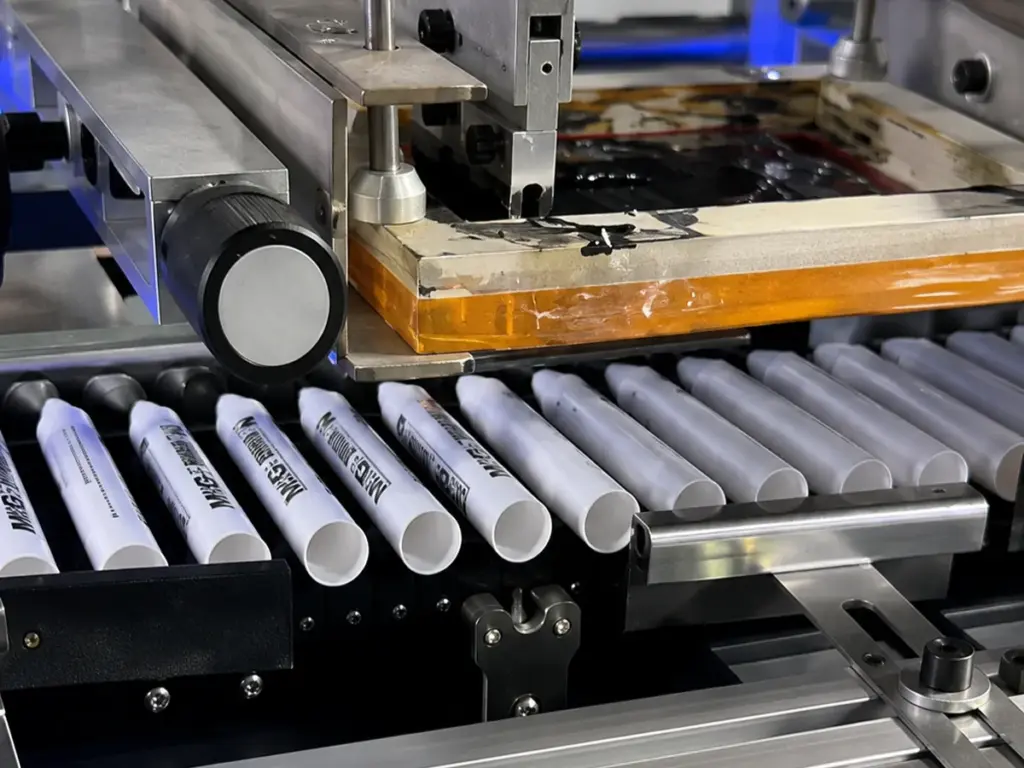
Screen printing applies ink through a fine mesh screen onto the pen surface. It is commonly used when the design needs a strong, solid appearance.
Compared with pad printing, screen printing is generally better suited to relatively smooth and even surfaces. It works well for bold text, logos, and simple graphic elements.
A major advantage is the strong visual impact of solid colors. White, black, metallic, and other brand colors can create a clear contrast against the pen barrel.
Screen printing is often considered for:
- Corporate logo pens
- Promotional campaigns
- Event giveaways
- School and organization pens
- Simple single-color branding
However, the shape of the barrel matters. Highly curved, uneven, or very small printing areas can make screen printing less suitable.
When preparing artwork, buyers should also avoid making very small text or extremely thin lines unless the manufacturer confirms that the design can be reproduced clearly.
UV Digital Printing for Detailed Full-Color Designs
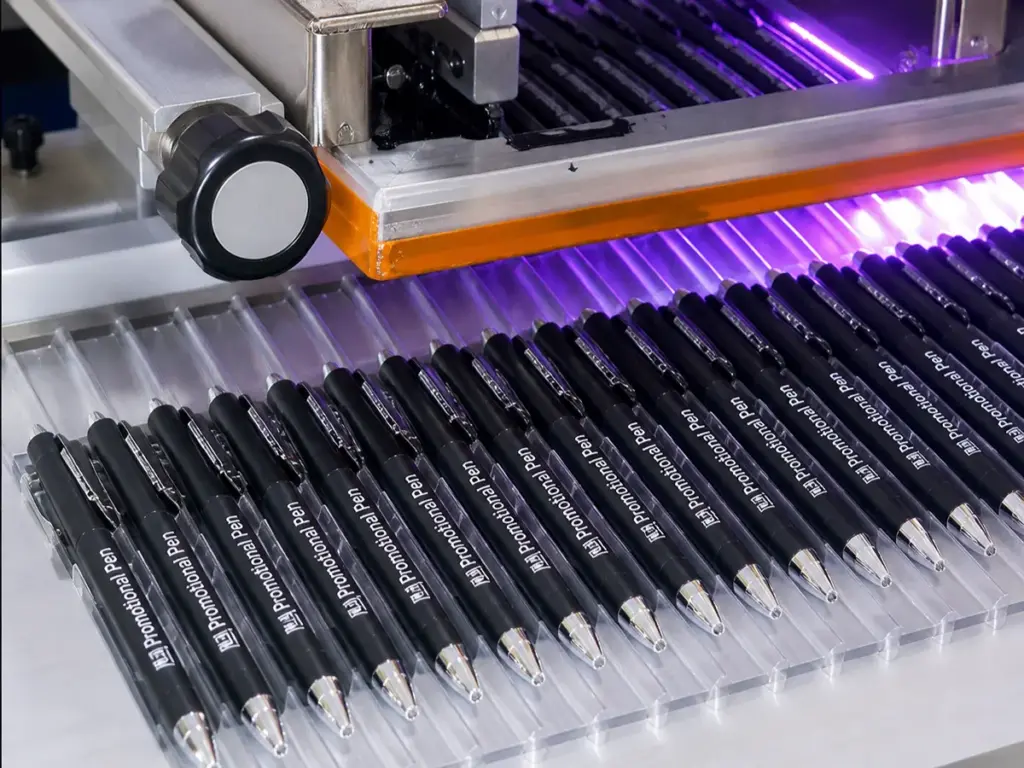
UV digital printing is a good option when the artwork contains multiple colors, fine details, gradients, or more complex graphics.
Core Technology and the UV-LED Curing Mechanism
Traditional analog print methods require physical plates and long setup times. Digital printing operates on a direct jetting process that removes these mechanical barriers.
- Piezoelectric Inkjet Heads: These components deposit UV-curable CMYK, white, and clear inks directly onto the pen barrel.
- Integrated UV-LED Lamps: These light sources cure the ink instantly, preventing ink spread to maintain sharp detail and minimal dot gain on curved surfaces.
- Direct-to-Object Application: This process eliminates the need for plates, screens, or transfer media, making short runs highly cost-effective.
Substrate Compatibility and Surface Treatment
Finding a single print process that handles both budget promotional plastics and premium alloys can be difficult. Industrial UV systems resolve this by bonding to diverse surfaces when prepared correctly.
- Material Versatility: The ink chemistry applies directly to common pen materials including ABS, acrylic, PVC, coated metals, and sealed wood.
- Surface Pretreatment: Low-energy plastics and coated metals may require flame, corona, or chemical primer treatments to ensure optimal ink adhesion.
- Curved Mechanics: Rotary attachments and specialized jigs allow printing around the curved pen barrel within a defined printable arc.
Production Workflow and Jig Registration
Speed in high-mix print jobs depends on minimizing alignment times and drying bottlenecks. A digital setup streamlines this progression from file to packaging.
- Jig Registration: Custom multi-pen jigs and templates hold multiple pens in precise alignment for accurate repeat registration across production batches.
- RIP Software: This software manages color conversion to CMYK, controls white ink underbases, and coordinates complex multi-pass printing.
- Immediate Finishing: Instant UV curing allows operators to handle, stack, and package pens immediately after printing, reducing lead times.
Design Rules and File Preparation Guidelines
Printing on a miniature cylindrical barrel demands strict artwork preparation. Errors that go unnoticed on large flat substrates become glaring defects at pen scale.
- Format and Resolution: Designers should create artwork in high-resolution vector formats or 300 DPI raster files converted to CMYK to prevent color shifting.
- Bleed and Safe Zones: Using slightly oversized designs with proper bleed and safe zones prevents unprinted slivers and accounts for positioning tolerances.
- Opacity Layers: You must configure a white underbase for dark or clear pen barrels to ensure vibrant CMYK colors and maintain graphic opacity.
Special Effects and Variable Data Personalization
Digital printing goes beyond static logo duplication. Modern setups leverage ink thickness and variable datasets to create high-value tactile items.
- Varnish Textures: Clear varnish inks enable tactile spot gloss, matte finishes, and 3D textured printing on premium pen bodies.
- Variable Data Personalization: Special software allows direct, pen-by-pen printing of individual names, serial numbers, and unique QR codes without hardware changeover.
- Metallic Simulating Graphics: Selective CMYK printing over bare metallic pen bodies creates reflective, metallic-sheen graphics without expensive foil stamping.
Laser Engraving for Premium Metal Pen Finishes
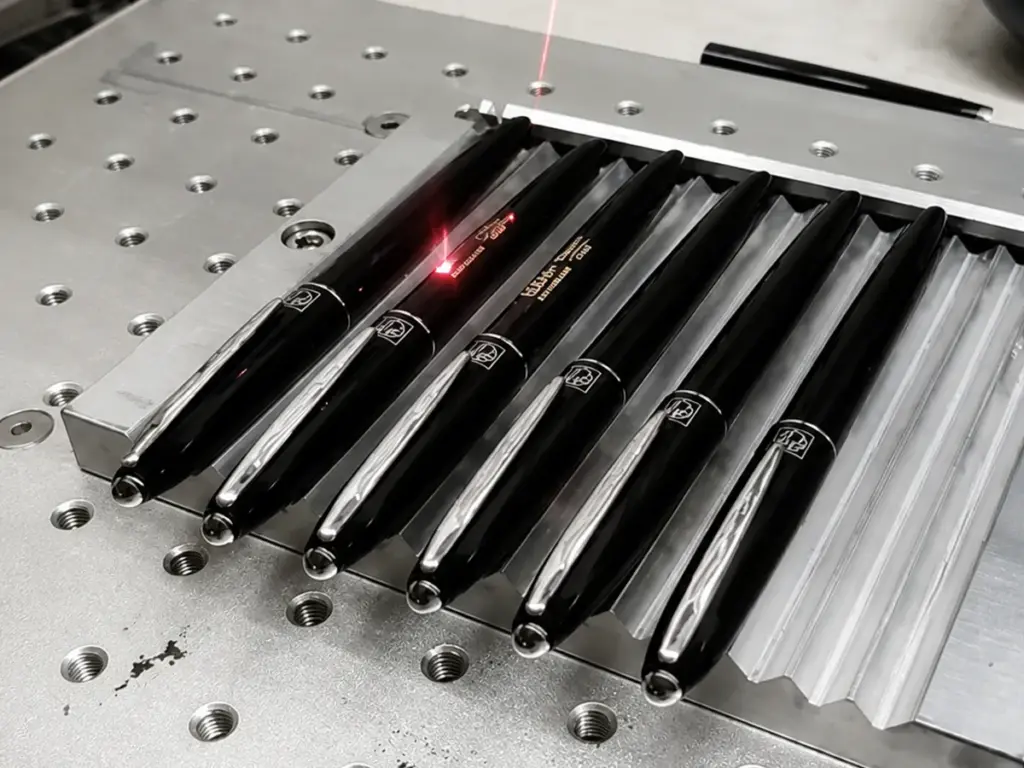
For धातु कलम, laser engraving is one of the most popular branding methods.
Durability and Aesthetics Compared to Ink Printing
Traditional ink-decorating methods sit on top of the substrate as a vulnerable film. Constant contact with keys in a pocket or natural hand oils degrades the print, eventually turning a high-end corporate gift into an unbranded piece of waste.
- Surface Alteration: Engraving physically cuts or alters the metal surface, making the mark permanent under normal handling.
- Chipping Resistance: Traditional pad or UV printing layers chip, scratch, or wear off over time under mechanical friction.
- Chemical Immunity: Engraved marks resist common office solvents, skin oils, and harsh mechanical wear without fading.
Compatible Substrates and Surface Coatings
Choosing the right pen body material dictates the final visual contrast of the engraved mark. Because different metals react uniquely to laser energy, operators must match the laser parameters to the specific substrate and surface coating.
- Anodized Aluminum: Provides clean, high contrast by vaporizing the dyed outer layer to expose the lighter metal underneath.
- Stainless Steel: Enables dark annealed oxide marks with smooth, tactile finishes that do not compromise structural integrity.
- Plated Brass: Exposes a classic warm brass tone when the laser ablates the outer lacquer or plating.
Process Workflow and Calibration Settings
Executing high-tolerance branding on a cylindrical, small-diameter pen barrel requires specialized fixturing and exact calibration. Standard flatbed configurations fail to maintain focus without rotational control.
- Rotary Alignments: Rotary attachments or custom multi-pen fixtures ensure accurate alignment along curved barrels to prevent image distortion.
- Laser Selection: Fiber lasers operating at 1064 nm target bare metal, while CO2 lasers remove lacquer or painted coatings.
- Calibration Parameters: Lower marking speeds of around 100 mm/min produce deep, high-contrast engravings on tough materials.
Aesthetic Enhancements and Quality Control
While raw laser engraving yields clean results, premium lines often incorporate post-laser treatments to introduce brand colors or distinct textures. Strict quality control keeps fine details sharp.
- Color Backfilling: Enamel, paint, or colored epoxy backfilling adds brand-specific colors to the recessed engraved cavities.
- Subtle Texturing: Tone-on-tone textures offer high-end appeal without relying on bright inks, maintaining a refined executive look.
- Inspection Standards: Post-process inspection guarantees the final product lacks heat halos, burrs, or flaking around fine text.
A well-executed laser process guarantees that premium metal writing instruments maintain pristine, sharp branding for their entire operational lifespan, protecting the initial marketing investment.
Sublimation and Heat Transfer for Special Pen Projects
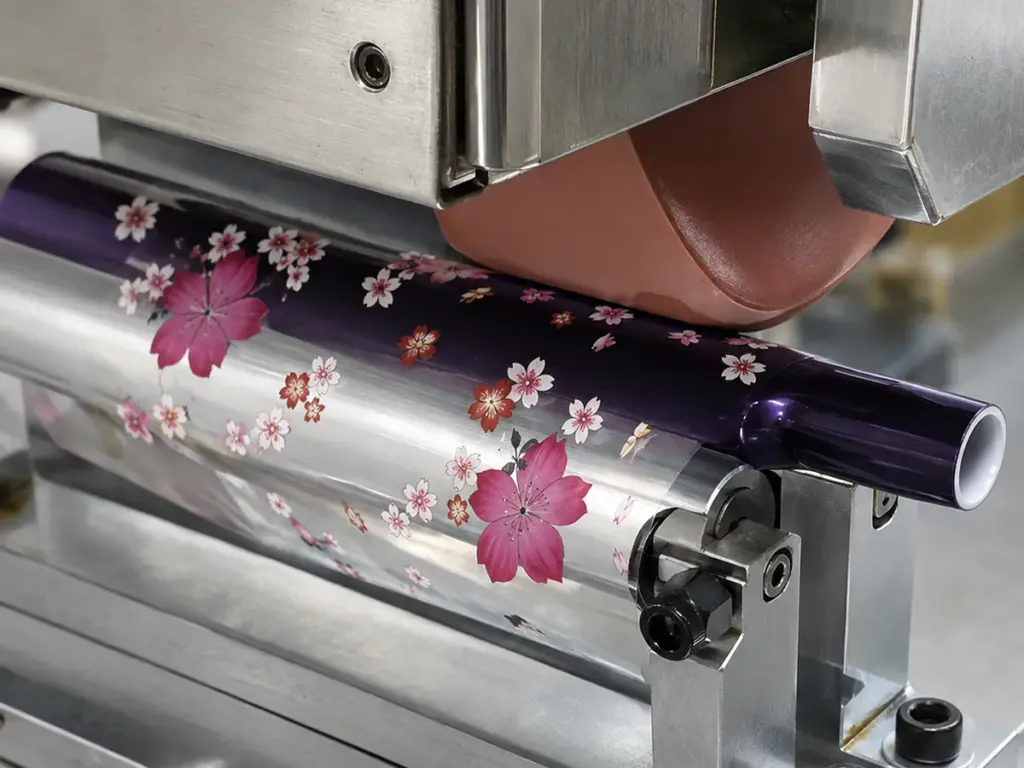
Sublimation and heat transfer are more specialized options. They are generally used on pens with suitable coated surfaces rather than on every type of plastic or metal barrel.
Technology Fundamentals and Compatible Substrates
Standard ink-based printing sits on top of substrates, exposing logos to friction and solvent damage. Transitioning to sublimation and heat transfer for special pen projects reverses this vulnerability by using heat and pressure to gasify specialized ink, permanently fusing it into a polyester or polymer coating on the pen barrel itself.
This process requires dedicated sublimation pen blanks. Compatible barrels feature pre-coated polymer surfaces over white or light-colored aluminum, stainless steel, or plastic bodies. The light-colored base is critical to ensure maximum color accuracy and visual pop.
When executing full-wrap designs, matching your artwork to precise template dimensions is mandatory. Most standard sublimation pen barrels require templates measuring exactly 4.25 को 4.5 inches in length and 1.25 को 1.5 inches in width to prevent unprinted gaps or overlap errors.
Preparation, Wrapping, and Shrink Sleeve Application
Thermal transfer demands meticulous prep work. You must completely disassemble the pen beforehand, removing ink cartridges, clips, springs, and any non-coated plastic parts. Skipping this step guarantees melted components and ruined internal mechanisms.
After wiping down the bare barrel with an alcohol wipe to clear skin oils and dust, wrap the printed transfer tightly around the pen. Secure the paper with heat-resistant tape to prevent any shifting during the baking cycle. Even a micro-millimeter of slippage will cause ink bleed.
To finish preparation, slide a custom shrink-wrap sleeve over the taped pen. Run a heat gun evenly over the sleeve until it shrinks tightly. This provides the uniform mechanical pressure needed to eliminate air pockets and guarantee clean edge-to-edge ink transfer.
Heating Equipment and Process Parameters
Achieving the thermal activation window requires precise machinery. Different production volumes demand distinct heating platforms to maintain consistent heat across the entire cylindrical surface.
- Convection Ovens: Best for multi-pen batch cycles, running at 350 को 375 degrees Fahrenheit for 4 को 8 मिनट. Always space pens apart to avoid fusing the shrink sleeves.
- Dedicated Pen Heat Presses: Feature curved heating elements and automatic clamping. These units deliver fast, hands-free operation with uniform mechanical pressure on the barrel.
- Tumbler Presses: Can be retrofitted with modular pen attachments. Operators must carefully manage manual rotation and clamping pressure to prevent flat spots on the barrel.
How Pen Material and Shape Affect Printing Results
Pen printing is not a one-size-fits-all process. The same logo can look different depending on the material and shape of the pen. उदाहरण के लिए, choosing between different pen materials such as metal and plastic can significantly affect printing results, which you can learn more about in our guide on metal pen vs plastic pen.
प्लास्टिक पेन are commonly suitable for pad printing and screen printing. Some smooth plastic surfaces can also support UV printing.
धातु कलम are often suitable for laser engraving, while coated metal surfaces may also support certain printing processes.
Wood, bamboo, recycled materials, and other eco-friendly pen materials may require different preparation because their natural texture and color can affect the final appearance.
The barrel shape is equally important. A straight cylindrical surface is easier to print than a tapered or heavily curved surface. Clips, grooves, buttons, and textured finishes can also reduce the available printing area.
Before production, buyers should confirm:
- Pen material and surface finish
- Printable area
- Barrel shape
- Logo size
- Number of colors
- Artwork format
- Required durability
- Order quantity
This information allows the manufacturer to recommend a printing method that fits the actual product rather than simply choosing the cheapest process.
Which Pen Printing Method Is Best for Your Order?
Selecting the right pen printing method depends on your order size, pen material, and design complexity to balance budget, टिकाऊपन, and brand impact.
| Your Requirement | Recommended Method |
|---|---|
| Simple logo on curved plastic | Pad printing |
| Bold single-color branding | Screen printing |
| Detailed full-color artwork | UV digital printing |
| Premium metal pen | लेजर उत्कीर्णन |
| Special coated surface | Sublimation / heat transfer |
Core Customization Methods and Technical Strengths
Understanding the physical mechanics of ink transfer and material marking helps avoid common production bottlenecks. We evaluate the core technical strengths of each commercial process to match your artwork with the correct machine workflow.
- Pad Printing: This process acts as the versatile default for curved barrels and up to four spot colors using a silicone transfer pad to conform to irregular geometries.
- Screen Printing: This technique provides high-speed ink transfer ideal for bold, high-opacity logos and wrap-around barrel designs.
- Digital UV Printing: Direct-to-substrate printing delivers unlimited CMYK color gradients and photo-quality detail without the need for physical plates or screens.
- Laser Engraving: Computer-controlled beams physically etch metal pens to produce a precise, permanent, and high-end single-tone mark.
- Foil Stamping: Using heat and pressure, this method applies heat-activated metallic layers to create shiny, highly reflective branding accents.
Material and Design Compatibility Guidelines
Your choice of pen material dictates the technical boundaries of the customization. Applying mismatched methods to low-energy plastics or delicate metals leads to poor ink adhesion, image distortion, or surface warping.
- Plastic Pens: Smooth plastic substrates support pad, screen, and digital printing, along with foil stamping if the plastic formulation is heat-tolerant.
- धातु कलम: Metal barrels achieve the most durable finish with laser engraving, though specialized pad printing inks can handle multi-color branding on coated metal surfaces.
- Complex Graphics: Logos featuring gradients, shadows, or multiple colors require digital UV printing to maintain exact color accuracy and high-resolution details.
- Simple Vector Designs: Solid, clean designs with up to four flat colors are best suited to the Pantone Matching System (PMS) spot matching of pad or screen printing.
Impact of Order Volume and Setup Costs on Budget
Tooling costs can heavily skew your cost-per-unit if not aligned with the total run size. Some processes require physical clichés or screen setups, while digital options bypass physical tooling fees entirely.
- Massive Promotional Campaigns: Large-scale runs benefit from screen printing because the low per-unit cost easily offsets the initial setup fees for the mesh screens.
- Medium-Sized Orders: Production runs of several hundred units are most economical using standard pad printing setups with physical clichés.
- Small Batches: Short runs and highly personalized batches avoid traditional plates or screens entirely by using direct digital UV printing.
- Premium Customization: Laser engraving and foil stamping require custom setup dies or software programming but offer an exceptional return on perceived luxury value.
Matching Use Case Durability to Brand Positioning
The environment where your users handle the writing instrument determines the wear and tear it must withstand. Matching durability to brand positioning protects your promotional investment over time.
- Everyday Office Giveaways: Standard handouts rely on cured pad or screen inks to survive normal handling, pocket friction, and light abrasion.
- कार्यकारी उपहार: High-end corporate gifts and pens destined for outdoor work environments require laser engraving to prevent fading and scratching over years of heavy use.
- Product Launches: High-profile campaigns leverage shiny foil elements to stand out visually in crowded promotional spaces.
- Flat Packaging & Accessories: Full-color digital printing excels when customizing larger, flat surfaces like presentation boxes, gift cases, and wide clips.
Selecting the optimal decoration method ensures your branding remains clean, readable, and intact throughout the lifespan of the pen body. By balancing your design requirements, base material properties, and total budget, you can proceed with production parameters that match your brand goals.
Why do so many bulk orders of custom printed pens arrive with blurred logos, mismatched brand colors, or flaking ink? Understanding the structural printing limitations of these writing instruments beforehand prevents costly production bottlenecks and rejected batches.
Common Printing Limitations Buyers Should Know First
Every pen printing method has hard boundaries; ignoring geometry, color counts, and material adhesion limits guarantees high defect rates and ruined brand assets.
Color Count and Graphic Complexity Restrictions
High-volume production runs rely on mechanical processes that apply ink physically. This means your multi-colored corporate logo might require a complete redesign before it can touch a physical production line.
- Color limitations: Traditional methods like pad and screen printing limit designs to 1-4 solid spot colors because each shade requires a separate plate, screen, and setup pass.
- Gradient failures: Photographic transitions, complex shading, and half-tones do not replicate well under analog systems, forcing buyers to use digital printing which cannot perfectly match Pantone standards.
- Detail bleed: Fine text and micro-details bleed or fill in during screen and foil processes, which makes simplified vector artwork mandatory.
If your brand guidelines mandate strict Pantone matching alongside intricate color transitions, you will have to compromise on either the print method or the graphic detail.
Barrel Geometry and Print Area Constraints
You cannot treat a three-dimensional, curved pen barrel like a flat sheet of paper. The physical shape of the writing instrument dictates exactly where the branding can live.
- Circumference limits: Cylindrical or tapered barrels restrict the active printable area, making seamless 360-degree wrap designs highly difficult without specialized equipment.
- Inaccessible zones: Hardware features like clips, clickers, caps, and rubber comfort grips physically block the machinery, creating dead zones on the pen body.
- Focal distance distortion: Digital inkjet heads and foil stamping systems require a consistent gap to function, so irregular or sharply curved contours suffer from severe ink distortion.
Designing artwork without keeping these physical boundaries in mind leads to stretched logos and off-center text that ruins the premium feel of the product.
Substrate Compatibility and Adhesion Challenges
Different materials react to ink, heat, and lasers in vastly different ways. Selecting a pen body material without verifying its chemical compatibility with the printing method is a recipe for flaking logos.
- Engraving restrictions: Laser engraving relies on reactive metal substrates like aluminum, brass, or steel, which rules out low-cost plastics.
- Adhesion barriers: Slick plastics, silicone coatings, and soft-touch rubber finishes reject standard inks, demanding expensive pre-treatments like flame or corona discharge to prevent peeling.
- Thermal warping: Foil stamping subjects the pen barrel to intense heat and mechanical pressure, which easily warps thin-walled plastic models during high-speed runs.
Testing substrate compatibility early in the procurement phase keeps you from purchasing thousands of plastic blanks that cannot physically hold your logo.
Durability and Volume Cost Trade-offs
Buyers must balance the expected lifetime of the promotional product against the unit cost. What looks brilliant out of the box might fade within weeks of daily office handling.
- Ink degradation: Surface-level inks applied via pad, screen, or digital systems inevitably wear down when exposed to skin oils, hand sanitizers, and abrasive friction inside bags.
- Setup overhead: High physical setup costs for manufacturing screens and metal clichés make low-volume pad or screen printing runs cost-prohibitive.
- Scale dynamics: Digital UV printing removes setup costs for short orders, but its slow print speeds mean high-volume promotional runs carry a steep per-unit price premium.
Choosing the most cost-effective method depends entirely on your total order size and how long you need the corporate branding to remain legible on the barrel.
Why Work With Le-Tian Gifts for Custom Pen Printing?
Le-Tian supports businesses looking for custom pens and corporate gift solutions, helping buyers select suitable pen models and branding methods for different projects. This is especially useful when a company needs more than a standard promotional pen.
For corporate campaigns, व्यापार की शो, employee gifts, and client programs, custom pens can also be combined with branded notebooks and other promotional products to create a complete gift set.
Working with one supplier can simplify product matching, अनुकूलन, production coordination, and packaging. Instead of selecting a printing method separately from the pen, buyers can evaluate the pen material, design, branding process, and final application as one project.
If you already have a logo, target quantity, preferred pen material, or budget range, sharing these details early can help the manufacturer recommend a more suitable solution.
अक्सर पूछे जाने वाले प्रश्नों
What are the most common pen printing methods?
The most common methods include pad printing, screen printing, UV digital printing, laser engraving, and sublimation or heat transfer. The right method depends mainly on the pen material, shape, artwork, required durability, and order quantity.
What is pad printing on pens?
Pad printing transfers ink from an etched plate to the pen using a flexible silicone pad. Because the pad can conform to curved surfaces, it is widely used for branding plastic pens with small logos, text, and simple graphics.
Which pen printing method is the most durable?
Laser engraving delivers the highest durability because the laser beam physically cuts into the metal pen body, creating a permanent mark that never rubs off. For plastic pens, screen printing stands out as the most durable ink-based option, laying down a thick, robust layer of cured ink that resists constant handling.
Can pens be printed in full color?
हाँ, digital UV direct printing and CMYK pad printing both handle full-color designs. Digital UV printers jet ink directly onto the barrel and cure it instantly with ultraviolet light, capturing complex gradients, fine details, and multi-color logos without requiring physical setup plates.
Is laser engraving better than printing for metal pens?
Laser engraving excels on metal pens by creating a crisp, permanent mark that lasts the lifetime of the pen, establishing a premium look. Surface printing on metal is only preferable when strict brand guidelines require exact multi-color matches or gradient graphics.
How do I choose the right pen printing method?
Make your choice based on material, artwork complexity, and production volume. Use laser engraving for metal pens to secure a permanent, high-end finish. Choose pad printing or screen printing for high-volume plastic runs with simple spot-color logos, and deploy digital UV printing for small batches requiring complex, full-color designs.