Traditional pen decoration charges per color: one mesh screen, one registration pass, one setup fee for each color in the logo. A pen factory shipping close to 10 million units a year still works under that rule on every screen-printed job. Digital printing breaks it—the artwork file is the setup.
This guide covers how digital printing works on pen barrels, where it beats pad and screen printing, where it still loses, and how the process decision fits into an OEM pen order. The production numbers come from the company’s facility data; the process limits are the ones that decide real quotes.
Key Takeaways
- Digital printing jets ink directly from a file: no plates, no screens, no per-color setup.
- Full-color artwork, gradientes, and photographic detail print in one run, with no per-color setup.
- Short runs and multi-color logos are where it beats pad and screen printing on cost.
- Dark barrels need a white underbase pass before the colors go down.
- QC at Le-tian Gifts includes ink stability testing and 48-hour salt spray tests on metal parts.
- Cantidad mínima de pedido 100 unidades; sampling 5–10 días, mass production 14–25 días, quotes within 6 hours.
What Is Digital Printing?
Digital printing on pens is inkjet deposition: print heads fire microscopic droplets of ink directly onto the barrel, building the artwork layer by layer from a digital file. Pen-line systems run UV-curable ink—ink that hardens instantly under UV light the moment it lands. There is no plate and no screen: the artwork file alone defines what gets printed.
The principle is an office printer scaled down to a cylinder and hardened for factory duty. What changes commercially is what disappears: per-color setup. A logo with one color and a logo with twelve cost the same to prepare, because neither needs a physical tool.
The terminology varies by supplier: impresión ultravioleta, digital inkjet, direct-to-object printing. They describe the same family—files in, cured ink out, no tooling—so confirm the process behind the label when comparing quotes.
How Digital Printing Works on Pens
Four stages take a file from artwork to finished barrel, and two of them decide whether the print survives:
- File preparation. The logo is flattened into print channels, including a white channel for dark barrels; gradients and photos pass through untouched.
- Barrel fixturing. Pens load into jigs that rotate them under the print heads at a constant speed and distance.
- Impresión. Head passes lay color down in micron-thin layers; dark barrels get the white underbase first so colors read true.
- Curing. UV lamps lock each layer the instant it lands, so the print leaves the station already handled.
The tell of a well-run digital line is the wrap seam, where the image closes around the barrel. A clean fixture keeps it invisible; a loose one prints a visible double edge through the logo. Ask to see a sample barrel rotated under light before you approve a full run.
Artwork rules also differ from the traditional processes. Screen and pad printers want vector files because every curve becomes a physical tool; digital printing takes high-resolution bitmap files without complaint, so photographic and painted artwork goes straight to the barrel. Resolution still matters: 300 dpi at print size is the practical floor, and artwork lifted from a website shows pixelation at scale.
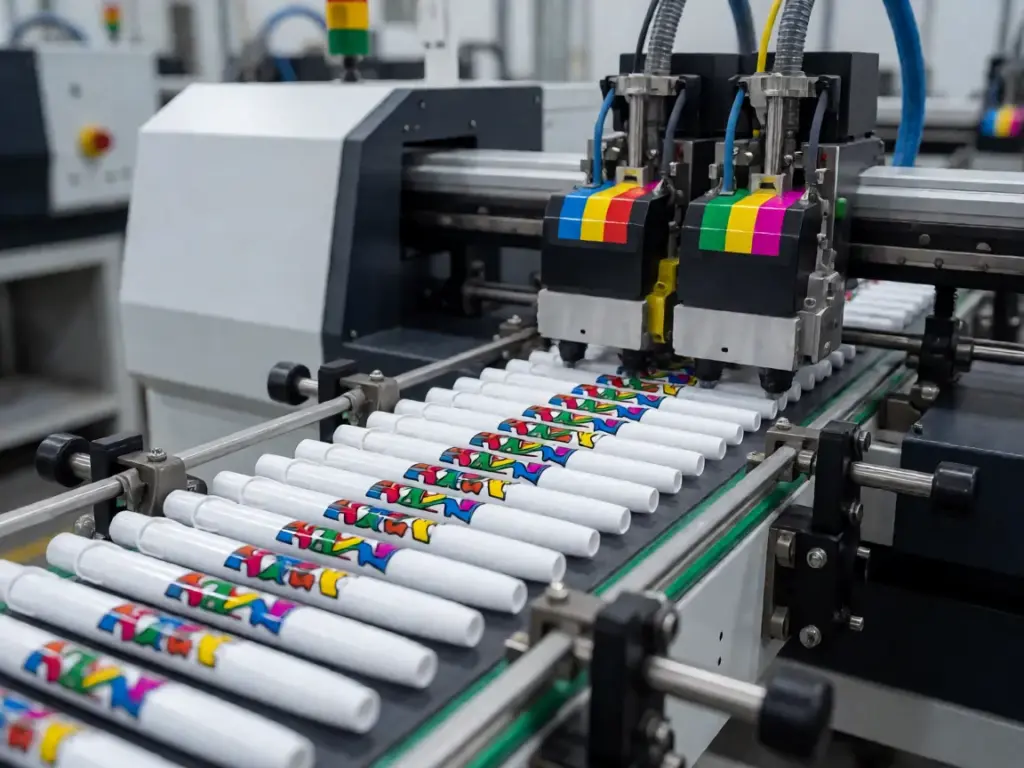
Digital printing heads laying full-color artwork onto white pen barrels: illustrative process image. The wrap band width on your barrel model decides how much artwork fits.
Advantages of Digital Printing
Four advantages explain the pull, and all four trace to the same root: no physical setup.
- Full color, one pass. Gradients, photos, and twelve-color marks print with the same effort as a one-color logo.
- Flat short-run economics. Nothing to amortize, so 100 units carry no setup penalty against 1,000.
- Fast sampling. Change the file and print; revised artwork does not wait on new plates or screens.
- Design freedom. Photographic portraits and complex gradients transfer faithfully, which spot-color processes approximate poorly.
The advantage that changes buyer behavior is iteration. Testing three logo variants on the same barrel no longer means paying three setup charges, so the cost of being wrong drops. Buyers test more variants and commit with better evidence.
There is a fifth that only digital offers: variability. Because each pass reads from a file, names, numbers, or per-unit codes can change from one pen to the next. Corporate gifts carrying an employee name, or event runs serialized unit by unit, are jobs the traditional processes simply cannot price.
Limitations of Digital Printing
Know where the process loses before you assign it a project:
- Unit cost at volume. On a plain one-color logo at five figures, screen printing still wins; inkjet cannot match a mesh stroke running in seconds.
- Thin ink film. The layer is measured in microns, so scratch resistance depends on ink-to-barrel adhesion and full cure—weaker than a laser mark burned into metal.
- Dark-barrel tax. Deep colors need the white underbase first, an extra pass that adds cost on every unit.
- Geometry limits. The print zone is a wrap band; deep curves, clips, and near-cap areas still belong to pad printing.
The failure mode to police is adhesion. A digital imprint made without material-matched ink and cure checks looks flawless on delivery and scratches by month two in a pocket. Insist on adhesion testing on the real barrel material before the production slot is confirmed. En los regalos de Le-tian, that request lands in a QC process that already runs ink stability testing and 48-hour salt spray tests on metal parts.
One limitation deserves its own paragraph: Pantone fidelity. Digital printing builds color from CMYK channels, and not every Pantone reference lands inside that gamut—vivid oranges and reflex blues are the usual casualties. Spot-color processes mix the exact shade, so brands with hard-locked Pantone codes should test-print on the real barrel before assigning the job to digital.
Best Applications for Digital Printed Pens
- Full-color brand marks. Logos carrying gradients, or more spot colors than the budget can screen.
- Photographic and artistic designs. Museum shops, artist collaborations, anniversary editions.
- Multi-design batches. Event sets where several artwork variants share one production slot.
- Prototyping. Real-barrel samples before any plate or screen is committed.
These briefs cluster where brand teams control design intent rather than price per unit. Browse the bolígrafos personalizados range and shortlist barrel models with a wide print band; ask the supplier to state the wrap height in millimeters on the quote, because that single number decides how much artwork the process can show.
Digital Printing vs Traditional Printing Methods
The table is the argument—each row is a decision you make on every order:
| Aspect | Digital | Pad | Screen |
|---|---|---|---|
| Setup per color | None; file only | One cliché plate per color | One mesh screen per color |
| Color capability | Full CMYK, gradientes, photos | 1–4 spot colors | 1–3 spot colors practical |
| Cost curve | Flat; no setup to amortize | Setup amortizes with volume | Setup amortizes hardest at volume |
| Detail and gradients | Excelente | Fine detail yes; gradients no | Bold solids; detail ceiling |
| Sweet spot | Short runs, full-color art | Curved barrels, fine logos | Straight barrels, one-color volume |
The verdict: assign digital printing to short, colorful, design-heavy briefs; assign pad and screen to volume. Heat transfer covers another middle ground—full-wrap designs on curved barrels—and the production flow behind it is covered in how sublimation pens are made. All four processes sit inside the wider set of pen printing methods; the artwork and the quantity pick the right one.
A worked example makes the crossover visible. A 500-unit order with a six-color gradient logo has no screen-print route worth quoting: six screens would dominate the cost. The same brief at 20,000 units usually gets redrawn into a simpler spot-color mark, because the setup now amortizes and the per-unit imprint cost falls sharply. The artwork brief and the quantity are one conversation, not two.
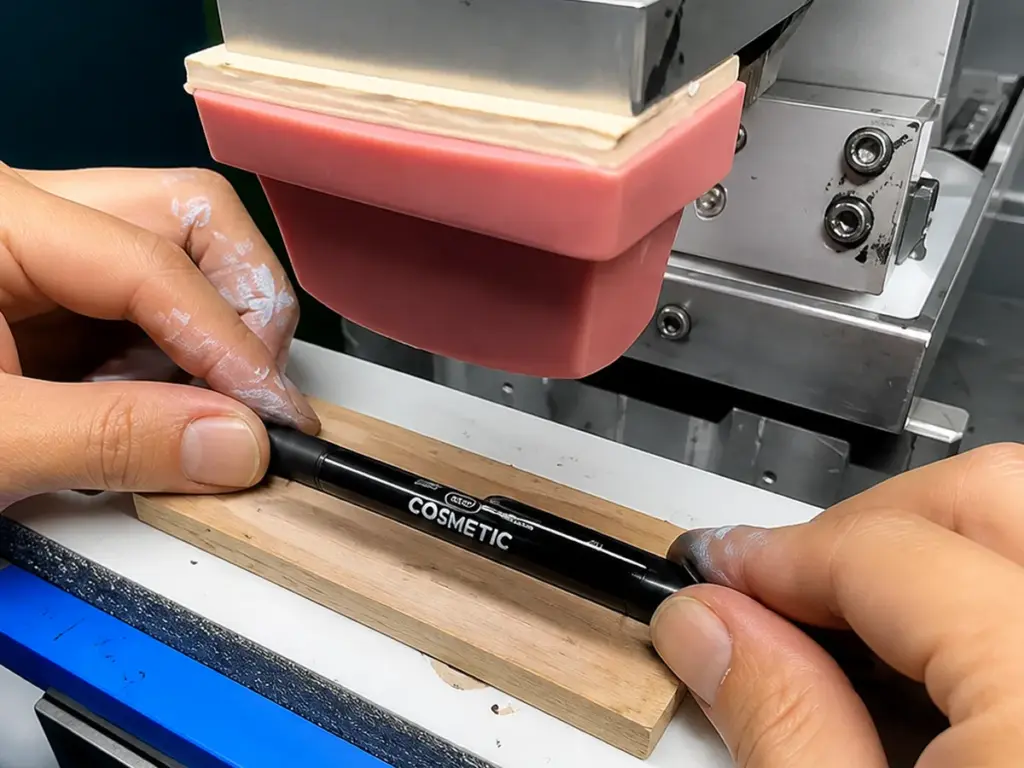
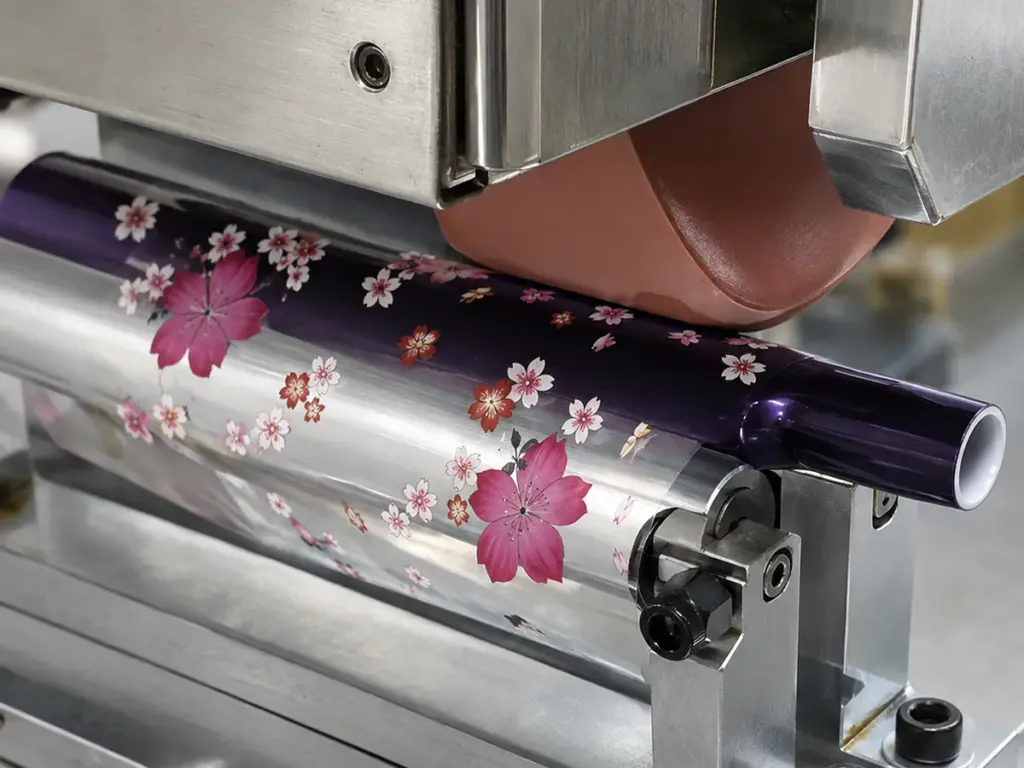
Pad printing on a curved barrel: still the assignment for geometry a digital wrap band cannot reach.
Planning a Full-Color Pen Run?
Send the artwork file and get a process recommendation with your quote, plus a free design mockup.
Cantidad mínima de pedido 100 | Free mockup| Quotes in 6 hours
Explore Our Products →Choosing the Print Process in an OEM Pen Order
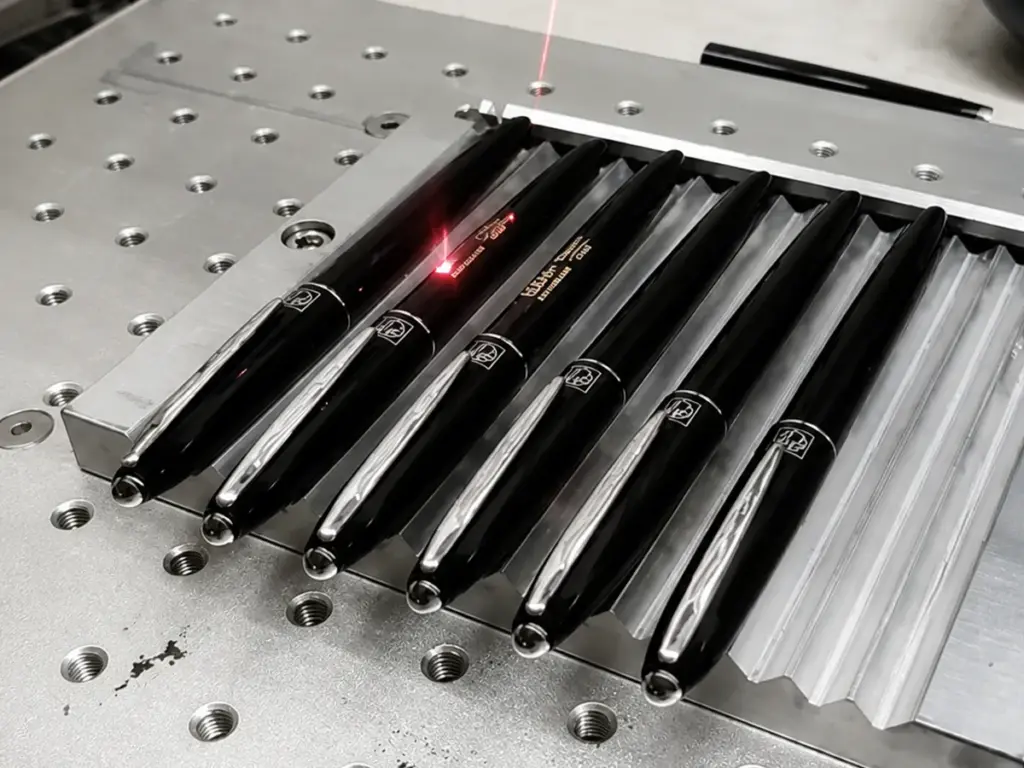
Process assignment is part of the quote, not an upsell. When a brief arrives, the artwork decides the route: single-color volume is the classic screen-printing job, full-color short runs are the natural digital candidates, curved barrels with fine logos favor pad printing, and metal marking goes to the laser station at 0.1mm precision. The buyer gets the reasoning alongside the price, so the decoration decision is auditable.
The commercial frame is fixed: quotes within 6 hours, a free design mockup with every inquiry, sampling in 5–10 days after artwork approval, mass production in 14–25 días, minimum order 100 unidades. Production sits at the Wengang, Jiangxi facility—China’s pen capital—on ten automated and semi-automated lines with annual capacity near 10 million pens.
Mixed decoration is the normal case in practice. A product family might ship with laser-engraved metal caps and screen-printed plastic barrels, all anchored to one brand palette verified through VI color matching. Coordinating the processes under one project is what keeps the family visually consistent at delivery.
Documentation travels with the order: product certificates include SGS, MSDS, and EBO, and the factory is audited to RoHS, BSCI, and TÜV Rheinland standards. For programs that mix decoration methods across a pen family, el Servicios OEM y ODM team manages artwork, process assignment, and QC as one project; start at Regalos le-tian with your artwork file and quantity.
Preguntas frecuentes
What is digital printing on pens?
An inkjet process that sprays ink directly onto the barrel from a digital file, building full-color artwork layer by layer with no plates or screens.
Is digital printing durable on pens?
Sí, when the ink is matched to the barrel material and fully cured. Adhesion and curing checks belong in the production process, not after it.
Is digital printing cheaper than screen printing?
For short runs and multi-color logos, yes: there is no per-color setup. For plain one-color logos at high volume, screen printing stays cheaper per unit.
Can you digitally print on dark pens?
Sí. A white underbase is printed first so colors read true on dark barrels; it is an extra pass, so dark-barrel runs cost slightly more.
What designs suit digital printing best?
Gradients, photographs, and multi-color logos without a spot-color budget. Fine line art on curved barrels may still pad print better.
What are the MOQ and lead times?
Orders start at 100 unidades. Sampling takes 5–10 days after artwork approval; mass production runs 14–25 days depending on the model.