A corporate gift budget is a plan that assigns spending across a recipient list before quotations arrive, covering the items, the customization, the packaging, and the freight that turns a quote into delivered gifts.
For HR teams, procurement managers, and office managers running a holiday program, it offers the most dependable defense against the two standard failure modes: a configuration that gets approved before the price is known, and hidden costs that surface after the order is placed.
Before approving a holiday budget, buyers should evaluate the recipient tiers, the cost drivers behind each quote, the split between clients and employees, and the calendar that fixes when money is actually spent.
This guide explains what a holiday gift budget covers, how per-unit ranges behave by tier, which costs hide inside quotes, and where a budget template can be adjusted without losing perceived value.
Key Takeaways
- A holiday gift budget covers five layers: items, customization, Verpackung, freight and duties, and a contingency line.
- Per-unit cost depends on quantity, Materialien, branding method, und Verpackung, so budget by tier and confirm with real quotations rather than averages.
- Customization adds less than packaging often does: a printed box and insert can move unit cost more than the logo method on the item.
- Hidden costs are freight, duties, packaging upgrades, rush fees, and battery documentation for electronics — confirm each before the order closes.
- Le-tian-Geschenke: free design mockup with the quote, quotes within approximately 6 hours, sampling in approximately 5-10 Tage, gift-set programs from 100 Einheiten.
What Does a Corporate Holiday Gift Budget Cover
A complete holiday budget covers five layers, and quotes that look cheaper than expected usually differ on one of the later ones. The item layer is the gift itself: the notebook, Stift, mug, or set configuration per recipient tier. The customization layer is the logo work: branding method per item, artwork preparation, and sample costs. The packaging layer is the box, insert, sleeve, or mailer, plus any card or seasonal print.
The fourth layer is logistics: freight, insurance, duties, and destination handling, which vary by mode and by port and are quoted separately from unit prices. The fifth is contingency, a line for the configuration change, the top-up order, or the freight surcharge that holiday seasons reliably produce. A budget that names all five layers can be negotiated layer by layer; a budget that names only the item layer gets negotiated by surprise.

Typical Budget Ranges by Recipient Tier
Tiering is the practical structure for holiday budgets because recipient value varies more inside a company’s gift list than any single unit price can absorb. The reference structure below holds ranges open on purpose: unit pricing depends on quantity, Materialien, branding, und Verpackung, so the honest budget form is a tier split plus confirmed quotations, not a fixed number per head.
| Tier | Typical composition | Budget approach |
|---|---|---|
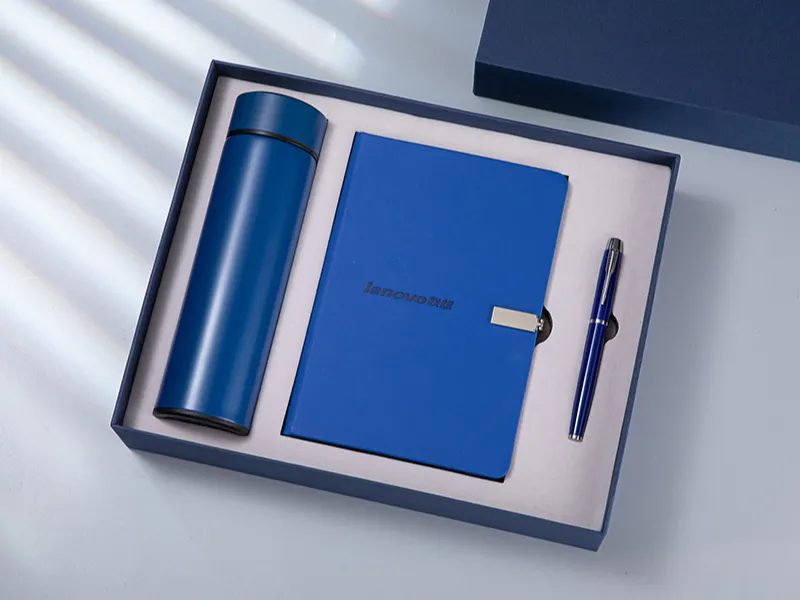
| Executive and VIP clients | Premium notebook, metal pen, presentation box | Set per-unit ceiling, confirm by quotation |
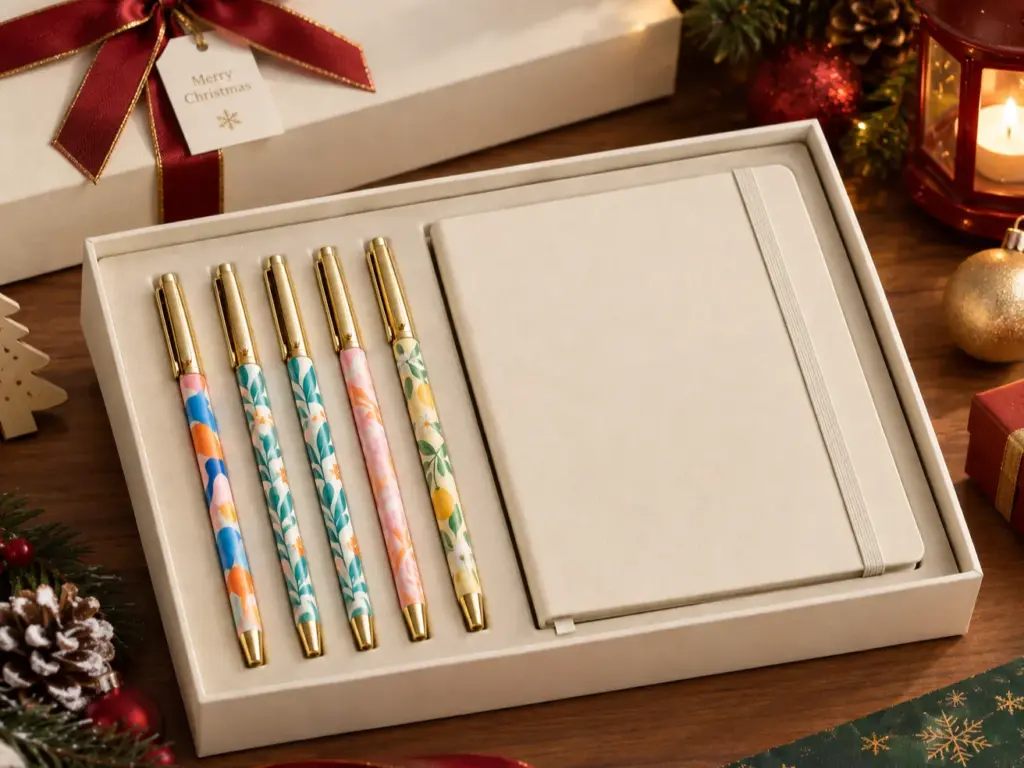
| Active clients and partners | Notebook and pen set, printed gift box | Mid per-unit band, confirm by quotation |
| Employees (company-wide) | Notebook or mug sets, uniform configuration | Volume pricing, confirm by quotation |
| Wide contact lists | Branded pen with sleeve or card pack | Entry per-unit band, confirm by quotation |
Three habits keep tier budgets honest. First, request quotations per tier, because a supplier prices a 4,000-unit pen order and a 300-unit executive set on different curves. Second, confirm what each quote includes — packaging, Einsätze, and freight are the usual omissions.
Third, hold tier definitions until the budget is approved, because tier creep, where a name moves up a tier, is the most common silent budget increase. Broader option lists organized by price band are covered in the corporate gift ideas overview.
Cost Drivers: Anpassung, Verpackung, and Quantity
Unit cost moves on three drivers, and they are not equally visible in a quote, which is why they deserve separate treatment before the budget is fixed.
Customization Method
Logo cost depends on the method and the surface: pad printing on plastic pens adds the least, engraving on metal pens adds a mid step, and multi-position or multi-color branding adds setup at every position. The method is also where quality perception is bought, so the driver to manage is the match between method and material rather than the method alone. Per-item pricing behavior is documented in the custom pen cost breakdown.
Packaging Specification
Packaging is the driver buyers underestimate. A printed box with a molded insert can move unit cost more than the logo method on the item inside it, and mailer-ready packaging adds weight that the freight layer later charges for. Confirm the packaging specification with the quotation, not after sampling, because late packaging changes void inserts and reprice the box.
Quantity and Its Breakpoints
Quantity pricing is not linear: it steps at breakpoints that differ by item and by supplier. The practical consequence is that two quantities either side of a breakpoint can quote very differently per unit, so the budget should test the real recipient count, the next breakpoint down, and the next one up, and pick deliberately. Gift-set programs at Le-tian Gifts start from 100 Einheiten, which is the reference floor for tiered programs.
How to Split Budget Between Clients and Employees
Client budgets and employee budgets respond to different logic, and splitting them by the same rule usually misprices one of the two. Client spending follows relationship value, so the split is tiered and the top tier is deliberately disproportionate. Employee spending follows headcount, so the split is wide and the configuration is uniform, because volume pricing and administrative simplicity both reward uniformity.
A workable reference split for a combined program is: set the client ceiling first, protect it, and distribute the remainder across the employee list, rather than averaging the two audiences into one per-head number. Confirm headcount and tier lists before sampling, because both programs are priced on confirmed quantities, and both move when lists move.
Where the same configuration serves both audiences, one production run with different packaging can serve both lists and consolidate the quantity discount, which matters more in Q4 than in any other season.
Hidden Costs Buyers Often Miss
The costs that break holiday budgets are rarely the quoted unit prices; they are the line items that were never quoted. Each of the following should be confirmed before the order closes, not discovered after it ships.
Freight, Duties, and Destination Handling
Sea freight is measured in weeks and air freight in days, and both vary by port, season, and carrier, so a per-unit budget built on ex-works or FOB pricing is not a delivered-cost budget. Ask for the freight estimate in writing and reconfirm it before production is booked, since Q4 rates move.
Packaging Upgrades and Late Changes
Upgrades agreed after sampling — a rigid box instead of a sleeve, a card in the lid, a molded insert for a mug — reprice both the packaging and, sometimes, the freight class. Confirm the full packaging specification in the quotation stage.
Rush Fees and Split Shipments
Programs that slip past their production window buy capacity back at rush pricing, and lists that were not finalized buy it again in split shipments. Both are calendar failures priced as budget failures, which is why the timeline in the next section belongs inside the budget conversation.
Compliance and Documentation for Electronics
Power bank notebooks and any set containing batteries carry documentation requirements, such as UN38.3 test summaries and safety data sheets, and destination-specific certifications may apply. The documents themselves are usually available; the cost is time and, occasionally, re-booking freight, so confirm them before the shipping plan is fixed.
Ways to Reduce Cost Without Losing Perceived Value
Budget reductions hold up when they cut cost where recipients do not look and protect cost where they do. The reliable levers, in rough order of how little perceived value they sacrifice:
- Consolidate the configuration. One notebook-and-pen set across two audiences earns the higher quantity breakpoint instead of two smaller runs.
- Simplify the packaging, not the item. A well-printed sleeve keeps the perceived quality of the item while removing the rigid-box line.
- Reduce branding positions, not branding quality. One clean logo position per item reads better than several small ones and removes setup cost.
- Move material one step, not several. A soft-cover notebook instead of hardcover holds the use case at a lower unit cost; switching to an unrelated item does not.
- Order earlier. Q4 rush pricing is the most expensive line item in a late budget, and early approval is the cheapest way to remove it.
The levers to avoid are the ones recipients touch directly: the pen’s writing quality, the notebook’s cover feel, and the box’s first impression. Savings taken there are visible, and a visible saving is the kind that undoes the program’s purpose.
Sample Budget Template by Company Size
The template below is a structure to fill with quotations rather than a set of numbers, because the same headcount can support very different programs depending on the tiers and markets involved.
The Template Structure
For each line: the tier, the confirmed headcount, the reference configuration, the quoted unit cost, the freight estimate, and a contingency percentage. Company size changes how the lines are weighted, not which lines exist. A smaller company typically runs two tiers — one executive line and one all-hands line — while larger companies add a partner tier and a wide-distribution line, and the freight line grows with the number of destination ports.
When the Budget Should Be Approved
The budget should be approved before quotations are requested in earnest, and quotations should be confirmed before sampling, because sampling fixes the configuration that production prices against. For a December in-hand date, the reference calendar is: budget approved in early autumn, quotes and mockups in September or October, samples approved while production windows are still open, and freight booked with a buffer. Für 2027 Planung, note that the Lunar New Year falls on February 6, and factory output in China typically contracts from late January into mid-February, so budgets approved late effectively buy January capacity at a premium.

Why Work With Le-tian Gifts on Your Holiday Gift Budget?
Le-tian Gifts traces its roots to pen-making in the mid-1990s and was formally incorporated in 2010. The company supplies customized writing instruments and corporate gift products, including notebooks, Geschenksets, and power bank notebooks, with manufacturing in Wengang, Jiangxi, and an export headquarters in Guangzhou.
For budget-driven programs, the relevant points are: quotes returned within approximately 6 hours with a free design mockup, so tier structures can be tested against real numbers early; production of pens, Notizbücher, and power bank notebooks within one portfolio, so consolidation levers are available; gift-set programs from 100 Einheiten; and reference lead times of approximately 5-10 days for sampling, 14-25 days for pen production, Und 10-15 days for notebook production, all to be reconfirmed against the season’s calendar.
The set configurations referenced in this guide are listed in the corporate gift sets category, and the program structures behind them are set out in the corporate gift sets pillar guide. Send the tier split, the headcount per tier, and the delivery month to Le-tian-Geschenke, and the reply will include quotes by tier and a mockup against the budget lines.
Häufig gestellte Fragen
What Is a Typical Corporate Gift Budget per Employee?
It depends on the industry, the tier structure, and the configuration. Company-wide employee gifts usually run on volume-priced notebook or mug sets, while executive tiers carry deliberately higher ceilings. Request quotations per tier rather than adopting a per-head average, since quantity, Materialien, and packaging move the number.
Should Clients and Employees Receive the Same Budget?
It depends on the program goal, but the two audiences usually answer to different logic: client spending follows relationship value and is tiered, while employee spending follows headcount and is uniform. Splitting the budget by that logic rather than by one average keeps both programs defensible.
How Much Does Logo Customization Add to Unit Cost?
It depends on the method and the surface. A single-position pad print on a plastic pen adds the least, engraving on metal adds a mid step, and each additional position or color adds its own setup. Confirm the branding method with the quotation, because method changes after sampling reprice the order.
What Hidden Costs Should a Holiday Budget Include?
Freight and duties, packaging upgrades agreed late, rush fees, split shipments, and documentation for battery-powered items. Each should be confirmed in writing before the order closes, and a contingency line should exist for the one that arrives anyway.
How Do I Keep the Budget From Growing After Approval?
Freeze the configuration, the quantities, and the packaging specification before sampling, and route every proposed change through a cost note rather than an approval email. Most post-approval growth comes from tier creep and packaging upgrades, both of which are visible before they are spent if the quotation lists them.
When Should a Holiday Gift Budget Be Approved?
Before quotations are requested in volume, and for December delivery that means early autumn, so sampling lands while production windows are open. Für 2027, factor in the Lunar New Year contraction around February 6: budgets approved late compete for January capacity at a premium.