Laser engraving is not automatically the premium choice, and printing is not the budget fallback—the opposite is true often enough to cost buyers real money. An engraved mark outlasts ink on the same barrel, but it cannot carry color, and on cheap barrels it highlights every surface flaw. A printed logo can hold four exact Pantone colors, yet it lives or dies by ink adhesion and curing discipline.
This comparison puts both methods against the decisions that actually move a branding project: 내구성, 색상, material fit, unit cost, and how each behaves on repeat orders. The verdicts come from production floor logic at 르티안 선물—a pen factory that quotes, samples, and ships both processes, and each section ends with a call, not a shrug.
Key Takeaways
- Laser engraving burns the mark into the barrel—영구적인, mono-color, and unmatched on metal.
- 인쇄 (pad or screen) applies ink in 1–4 spot colors matched to Pantone codes.
- Le-tian Gifts engraves with 0.1mm precision in its precision customization center—fine enough for tight-tracking logos.
- Engraving costs more per unit and pays back on metal pens kept for years.
- Printing wins volume giveaways: color branding at the lowest unit cost.
- Decision driver: 금속 + permanence → laser; 플라스틱 + 색상 + 용량 → print.
What Is Laser Engraving on Pens?
Laser engraving uses a focused beam to vaporize the barrel surface, burning the logo permanently into the material itself. No ink, no plates, no curing: the mark is a physical change to the metal or coated surface, so it wears only when the barrel does. On anodized aluminum the beam strips the coating to bare metal, producing a crisp light-on-dark contrast that reads as premium hardware.
Precision is the method’s second advantage. Le-tian Gifts runs laser engraving at 0.1mm precision in its precision customization center, tight enough to reproduce small logos, tight letter spacing, and thin rules that ink processes would blur. The trade-off is color: the beam carries no pigment, so the mark is always the exposed material’s tone.
Depth is the hidden variable buyers never see. It is stepped in micron-level increments: too shallow and the mark reads gray and washed out, too deep and it catches dirt and distorts the barrel wall. That window is why engraving belongs on a calibrated production laser, not a benchtop unit borrowed for the job.
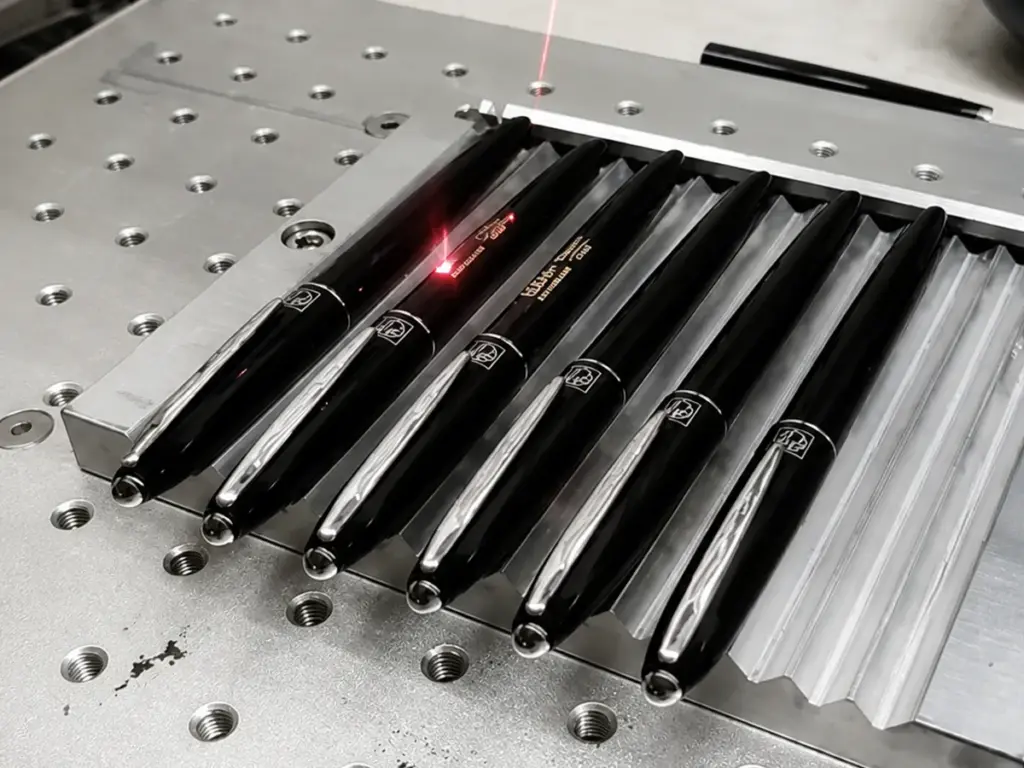
Laser station marking black metal barrels: the exposed-metal contrast buyers read as premium.
What Is Printed Branding on Pens?
Printed branding applies ink onto the barrel surface—pad printing from an etched plate for curved and fine work, screen printing through a mesh for bold coverage on straight barrels. Both are contact methods that lay a controllable ink film in spot colors mixed to Pantone references—the two workhorses among the common pen printing methods.
Printing’s advantage is chromatic: a pad printer applies 1–4 spot colors, so a two-tone logo with a tagline prints exactly as designed. Its dependency is adhesion—ink must be matched to the barrel material and fully cured, which is why imprint testing belongs in the order, not after it.
Ink selection follows the barrel: solvent-based inks for ABS and coated plastics, epoxy-type inks for metal, dedicated systems for soft-touch coatings. Getting that pairing wrong does not show up at the printing station—it shows up a month later, when the first boxes of pens come back from the field with faded or flaking logos.
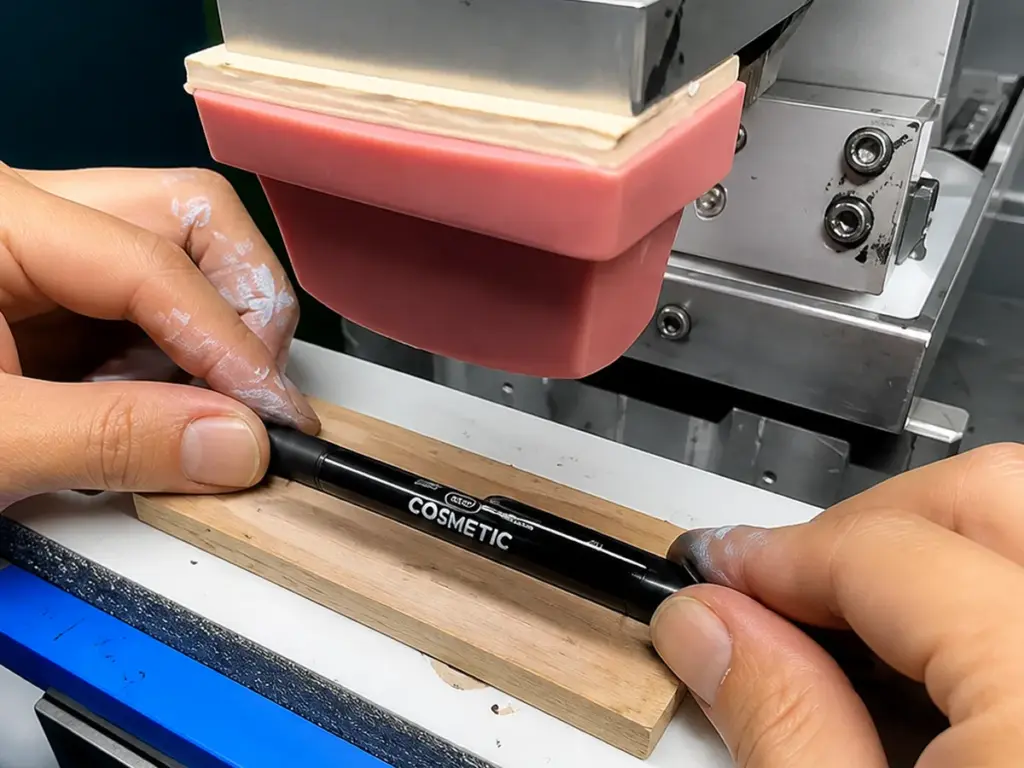
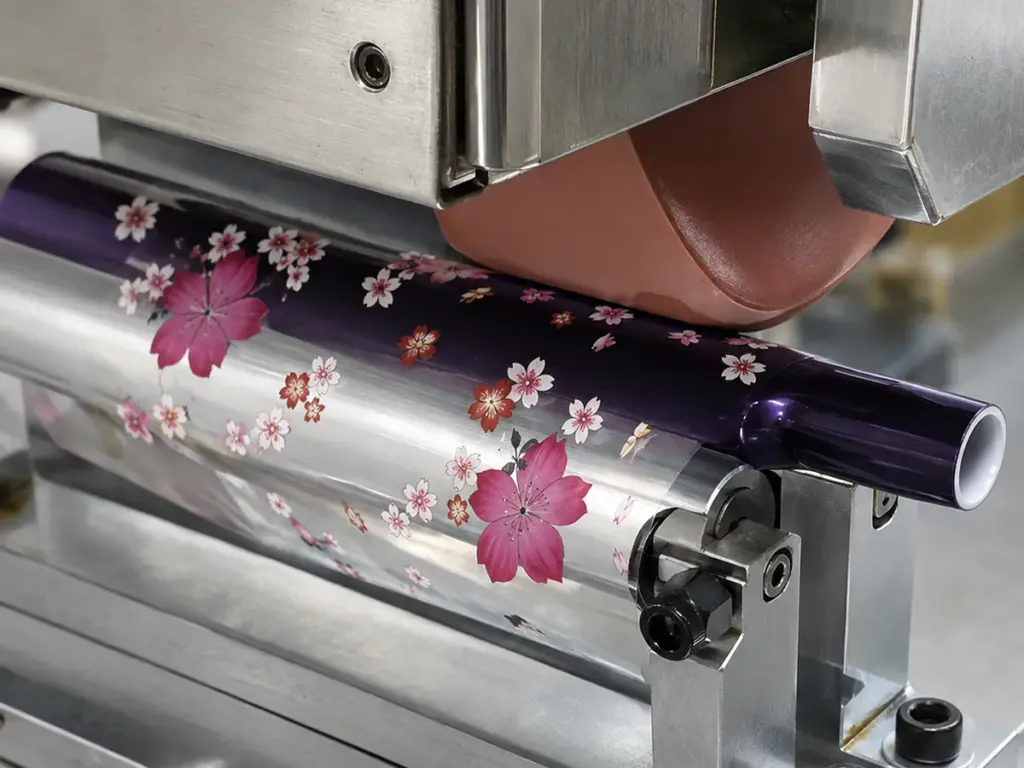
Pad printing transfers spot-color ink onto a curved barrel, the color capability engraving lacks.
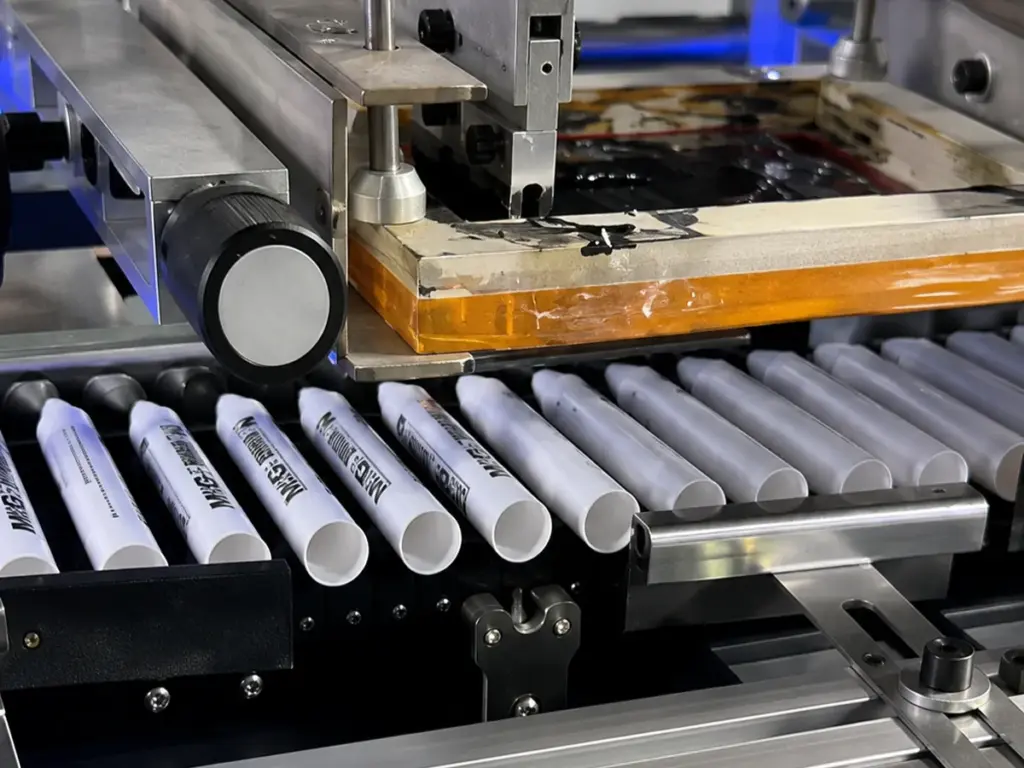
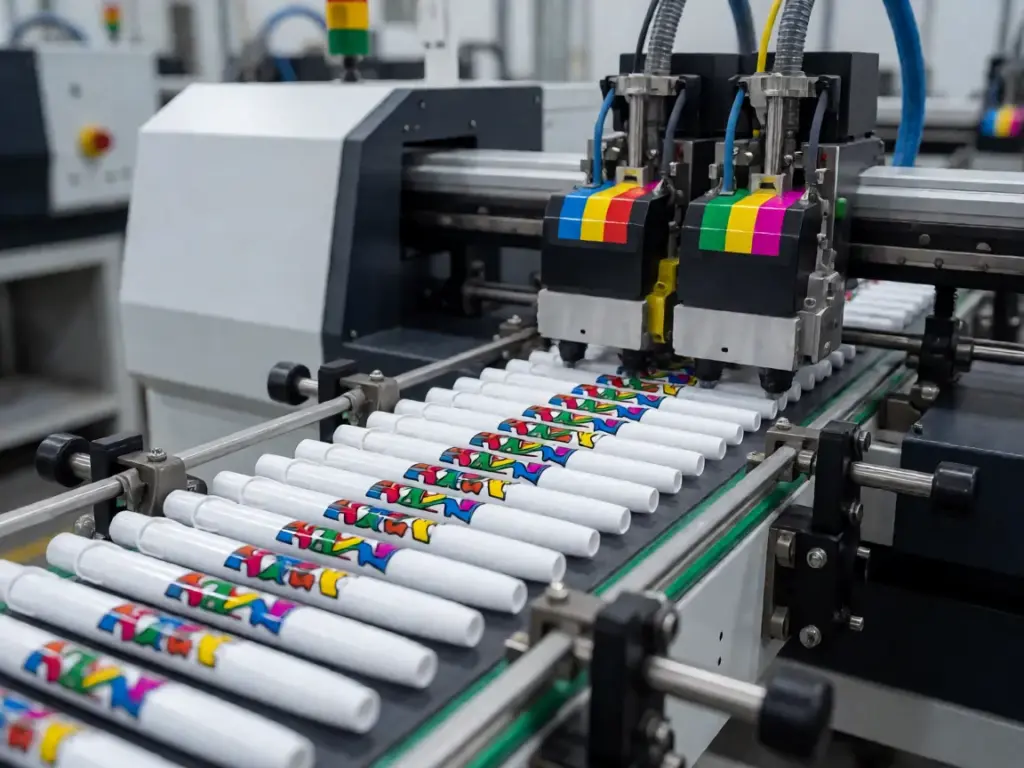
Screen line running straight barrels: bold one-color marks at the lowest unit cost in printing.
레이저 각인 펜과 인쇄 펜: 주요 차이점
The table below is the whole argument in six rows—each row is a question to answer before the PO goes out:
| Aspect | Laser Engraved | Printed |
|---|---|---|
| Mark composition | Material burned in; mono-tone | Ink film on surface; 1–4 spot colors |
| 내구성 | Permanent; survives abrasion and solvents | High when matched ink is fully cured |
| Detail level | Excellent at 0.1mm precision | Excellent on pads; good through screens |
| Material fit | Metal and anodized or lacquered surfaces | 플라스틱, 금속, coated, most surfaces |
| Cost profile | Higher per-unit; no plates or screens | Plate/screen setup; lowest unit cost at volume |
| Brand color match | 아니요—single material tone | Exact Pantone spot-color matching |
One row decides most projects: 색상. If the brand guideline requires specific colors—and most corporate guidelines do—engraving is out regardless of its durability, because the mark can only ever be the barrel’s own tone.
The cost row cuts the other way. Engraving carries almost no physical setup, so short metal runs are where it quietly wins on economics, while printing’s plate-and-screen setup needs volume to amortize—which is why the “cheaper” method depends entirely on your quantity and barrel, not on any universal price list.
When Should You Choose Laser Engraving?
- Metal executive and gift pens. The mark reads as machined hardware and outlasts the pen around it.
- Premium kits and VIP gifts. Permanence itself signals quality; nothing about the logo can fail in front of a client.
- Tools and technical giveaways. Multi-tool pens and tactical styles take engraving naturally: ink on knurled surfaces fails fast.
- Compliance marking. Serial or regulatory marks must not wear off; engraving is the audit-proof option.
Engraving also forgives re-orders: the setup is a digital file, not a physical plate, so a repeat order of 300 units years later reproduces the same mark. The premium is real—expect a higher per-unit cost than printing—but on a metal pen kept for years, cost per impression keeps falling long after a printed giveaway is gone.
When Is Printed Branding a Better Choice?
- Color-critical logos. Two-tone marks, logos with a tagline, brand palettes locked to Pantone: print is the only faithful route.
- High-volume giveaways. Five-figure runs on plastic barrels: printed unit costs stay low enough to hand pens away by the box.
- Plastic and soft-touch barrels. Ink systems exist for ABS, coated, and eco materials; engraving on cheap plastic looks scratched, not premium.
- Events on a deadline. Pad and screen lines run in seconds per unit once set, absorbing late volume spikes inside a 14–25 day production window.
The honest caveat: printed marks live on the surface. Insist on material-matched ink and full curing—Le-tian Gifts runs ink stability testing and 48-hour salt spray tests on metal parts in its QC center, because a cured imprint and an under-cured one look identical until week three of pocket use.
Volume changes the math, too. Setup spreads thin across big runs, which is why the per-unit gap between a one-color and a two-color logo looks huge at 1,000 units and nearly disappears at 50,000. Decide the logo first, then let quantity pick the economics.
Undecided Between Engraved and Printed?
Send one artwork file and get both methods quoted on your actual barrel—laser and printed samples compared side by side, from 100 단위.
MOQ 100 | Free design mockup| Quotes in 6 hours
Explore Our Products →Which Pen Materials Work Best with Each Method?
Material choice and branding method are one decision, not two—the metal pen vs plastic pen breakdown covers the barrel trade-offs; here is how branding lands on each:
- 알류미늄, stainless, 놋쇠. Engrave—especially anodized aluminum, where the two-tone contrast is free. Print only when color demands it, with cured metal ink.
- Hard plastic (ABS). Print—engraving melts and fuzzes most commodity plastics; matched inks hold fine detail.
- Soft-touch coated barrels. Print with coating-matched ink and demand a sample on the real barrel.
- Eco and recycled materials. Print on plastic-substitute materials; engrave wood and bamboo, where the burned mark suits the material story.
The same pairings, compressed for the PO meeting:
| Barrel Material | Recommended Branding | Why |
|---|---|---|
| Anodized aluminum | Laser engrave | Free two-tone contrast; 0.1mm detail |
| Stainless, 놋쇠 | Laser engrave | Permanence on hard metal; cured ink if color demands |
| ABS hard plastic | Pad or screen print | Engraving melts the surface; inks hold detail |
| Soft-touch coating | Pad print, matched ink | Engraving cuts through the coating layer |
| Wood, bamboo | Laser engrave | The burned mark suits the material story |
How to Choose the Right Branding Method for Your Business
Work the decision in order—each question eliminates one branch:
- Does the logo require specific colors? Yes → print. No tolerance for ink → continue.
- Is the barrel metal and the budget premium? Yes → engrave; the 0.1mm mark outlives the campaign.
- Is volume five figures on plastic? Yes → print; unit cost rules.
- Still undecided? Order both: one laser sample and one printed sample on the same barrel, 5–10 days at Le-tian Gifts, and let the desk test decide.
Cost is the tiebreaker, and it cuts both ways. Engraving skips plates and screens, so a 300-unit metal run carries almost no setup, while printing amortizes its setup over volume—pennies per unit at five figures. 그만큼 custom pen cost breakdown shows how barrel, 장식, and quantity stack into the final unit price, and the 맞춤형 펜 range is where you shortlist barrel models before either method gets quoted.
Buyers folding the choice into a wider program—barrel molds, 포장, mixed decoration across a product family—should route it through the OEM 및 ODM 서비스 team so artwork, ink selection, and process assignment are managed as one project. The team at 르티안 선물 quotes both methods side by side with a free design mockup and responses within 6 hours.
자주 묻는 질문
Which lasts longer, laser engraving or printing?
레이저 조각. The mark is burned into the material and cannot fade, 벗기다, or scratch off, while a printed mark depends on ink adhesion and full curing.
Can laser engraving reproduce my brand colors?
아니요. Engraving exposes the barrel material’s own tone, so it is mono-color. Color-critical logos need pad or screen printing with Pantone-matched inks.
Is engraving only for metal pens?
It works best on metal, anodized, and lacquered barrels—not soft-touch coatings, where matched printing inks perform better.
Which method costs less for bulk orders?
인쇄. After plate or screen setup, pad and screen lines run in seconds per unit, keeping five-figure runs at the lowest unit cost.
What precision does laser engraving achieve?
Le-tian Gifts engraves at 0.1mm precision, fine enough for small logos, tight letter spacing, and thin rules.
Can I get samples of both before deciding?
예. Le-tian Gifts produces physical samples in 5–10 days from 100-unit orders, so both branding methods can be compared on the same barrel.