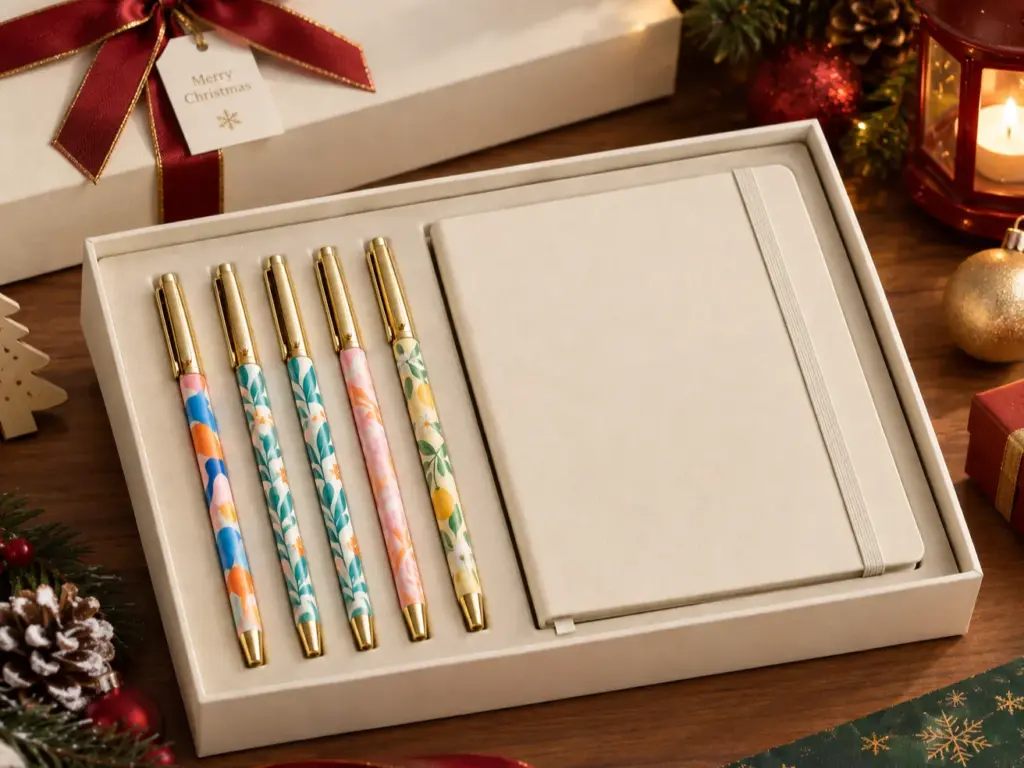
Pad printing is the default branding process for custom pens, and the reason is not price. A soft silicone pad wraps a crisp logo around a curved barrel without distorting it. No other common printing method handles small, curved, high-volume pen branding as well. That is why most custom pens on the market carry a pad-printed mark.
This guide breaks down how pad printing works, which pen materials accept the ink best, and where the process reaches its limits. You will also find a direct comparison with screen printing, plus the quality checks Le-tian Gifts runs on pad-printed pen orders.
Key Takeaways
- Pad printing transfers 1–4 spot colors onto curved or textured barrels through a silicone pad.
- Best fit: hard plastic, 金属, and coated pens carrying small to mid-size logos.
- Artwork should arrive as vector files (AI, EPS, or PDF) with Pantone color codes.
- Pad printing beats screen printing on curved barrels and fine detail; screens win on large solid prints.
- Le-tian Gifts runs ink stability tests and 48-hour salt spray tests on metal parts as standard.
- MOQ starts at 100 単位; sampling takes 5–10 days and mass production 14–25 日.
What Is Pad Printing?
Pad printing is an indirect printing process that transfers ink from an etched steel plate onto a pen barrel through a flexible silicone pad. The plate, called a cliché, carries your logo etched into its surface. The pad picks the ink film out of the etching and rolls it onto the pen, conforming to curves a flat printer cannot touch. The method is an established industrial process long used on watch dials and electronics before it became the workhorse of pen branding.
How the Pad Printing Process Works
Every pad-printed pen order follows the same four steps, whether the run is 500 units or 100,000:
- Artwork preparation. Your logo is converted to vector format and etched onto a steel cliché, one plate per color.
- Inking. Ink fills the etched artwork, and a doctor blade or sealed ink cup scrapes the plate surface, leaving ink only inside the etching.
- Pick-up. The silicone pad presses onto the plate and lifts the ink film out.
- Transfer and curing. The pad rolls across the barrel and deposits the logo; the imprint is then air-dried, heat-cured, or UV-cured.
Pad hardness is matched to the barrel shape, which is what lets the same machine print on a slim cylindrical pen and a flat clip. Among the common pen printing methods, pad printing is the one factories default to for curved, small-format logos at production speed.
Which Types of Pens Are Best for Pad Printing?
Pad printing performs best on hard plastic, 金属, and coated pens with a smooth or gently curved branding area. The choice between metal and plastic barrels affects more than branding, so it is worth settling before artwork is submitted—our metal pen vs plastic pen comparison covers that decision in depth. Material then determines which ink system the factory selects.
Hard Plastic Pens
ABS and similar hard plastics accept pad-printing ink readily and hold fine detail. Polypropylene is the exception: its low surface energy needs a specially matched ink or a surface treatment step, and a supplier who skips that test will ship barrels where the logo scratches off with a fingernail.
メタルペン
Metal barrels take pad printing well, and the imprint holds up better under daily pocket wear once the ink is fully cured. For metal parts, the imprint test that matters is salt spray exposure—Le-tian Gifts runs 48-hour salt spray tests as standard before shipment.
Soft-Touch and Coated Barrels
Soft-touch coatings feel premium but demand an ink series matched to the coating, or the imprint lifts at the edges. Always ask for a printed sample on the actual coated barrel, not on a generic plastic card.
Eco-Friendly and Recycled Materials
Recycled and biodegradable pen materials print acceptably, but surface texture varies from batch to batch. Pre-production samples protect both sides: the buyer approves the real imprint, and the factory locks the ink and curing parameters for the run.
Material fit at a glance:
| Pen Material | Pad Printing Performance | What to Confirm With Your Supplier |
|---|---|---|
| Hard plastic (ABS) | Excellent ink adhesion and sharp detail | Ink series matched to plastic type |
| 金属 | Durable imprint after full cure | 48-hour salt spray test report |
| Soft-touch coated | Strong results with matched ink | Printed sample on the actual barrel |
| リサイクル / eco materials | Workable; surface varies by batch | Pre-production sample approval |
Advantages of Pad Printing on Custom Pens
The process earns its default status on pen orders for five concrete reasons:
- Curved and irregular surfaces. The pad flexes around barrels, clips, and tapered shapes where a flat screen cannot keep contact.
- Fine detail. Small text, thin lines, and registered marks stay sharp because the ink film transfers from a rigid etched plate.
- Spot-color branding. A standard setup applies 1–4 spot colors, with one plate and pad per color, matching most corporate logos exactly.
- Speed and unit cost at volume. A printing cycle runs in seconds, so per-unit cost drops sharply on bulk runs.
- Repeat-order consistency. The same cliché reproduces the identical logo months later, which keeps re-orders visually uniform across a campaign.
For procurement teams, the last point matters more than it looks. A campaign that reorders three times a year needs imprints that match across reorder batches, and plate-based printing delivers that consistency by design.
Limitations of Pad Printing
Pad printing is not the right tool for every design, and pushing it past its limits is the most common way buyers waste a setup fee:
- Color ceiling. Beyond about four spot colors, or with gradients, each added color needs its own plate and pad, and registration errors stack up.
- Large solid areas. A silicone pad distorts big solid fills; screen printing lays down a more even ink film on those.
- Per-color setup cost. Multi-color artwork on a small run raises the per-unit cost, because every color carries plate and setup labor.
- Photographic artwork. Photos and full-color images are outside pad printing entirely.
When artwork is full-color or photographic, the practical routes are heat-transfer decoration or sublimation pens, which print the full design before it is applied to the barrel. Say so during quoting: asking a factory to pad-print a six-color gradient produces a soft, muddy imprint and a bill for five plates you did not need.
Get a Pad Printing Quote for Your Next Pen Order
Le-tian Gifts prints logos on plastic, 金属, and eco-friendly pens from 100 単位, with a free design mockup for every inquiry.
MOQ 100 | Free mockup| SGS-certified products
Explore Our Products →Common Applications of Pad Printed Pens
Pad-printed pens show up wherever a business needs its name in thousands of hands at a controlled cost:
- Corporate giveaways and onboarding kits. One-color logo, five-figure volume, strict budget—the classic pad printing profile.
- Hotels, restaurants, and banks. Pens stay on site for months, so imprint durability under constant handling decides the reprint cycle.
- Automotive, tech, and logistics brands. These buyers brief exact Pantone codes, and plate-based spot printing reproduces them faithfully; Le-tian Gifts supplies programs for Fortune 500 brands including Google, DHL, BMW, and Samsung.
- Trade fairs and events. Dates are fixed and volumes spike late; a 14–25 day production window fits when artwork is print-ready.
One boundary worth knowing: when a design needs a full-wrap pattern or gradient artwork, decoration moves to machines like the one below, and pad printing handles only the small logo mark.
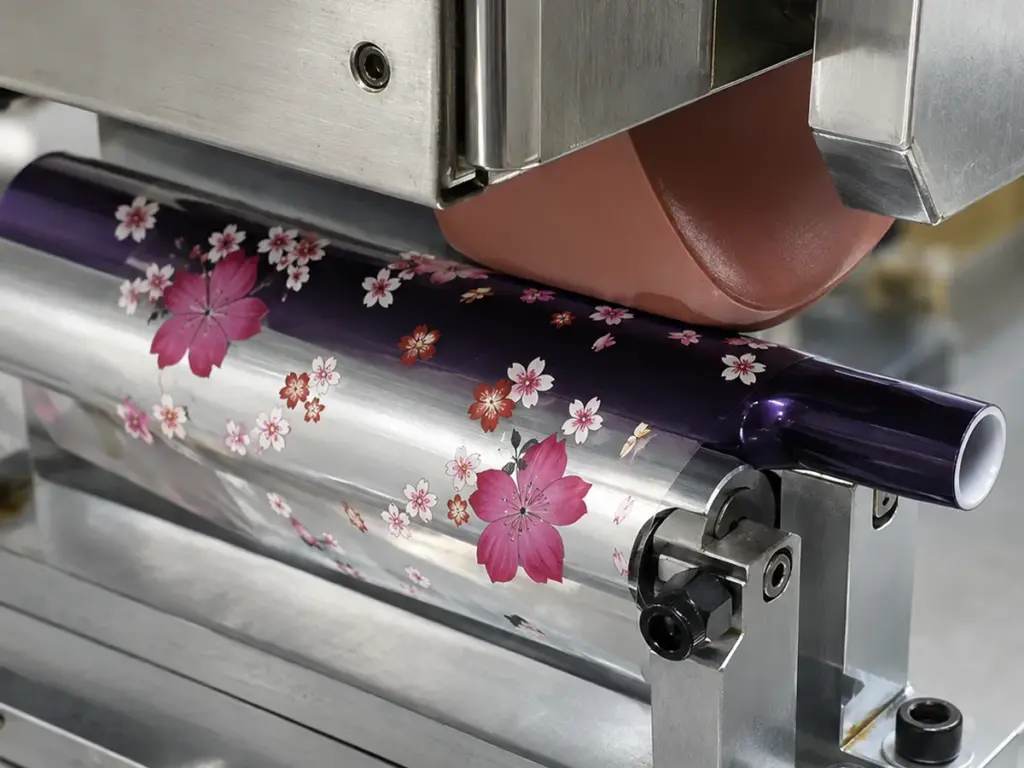
Heat-transfer and hot-stamping lines extend the decoration options; the pad printer still does the brand mark on the barrel.
Pad Printing vs Screen Printing: What’s the Difference?
Pad printing transfers ink with a silicone pad from an etched plate; screen printing pushes ink through a mesh screen onto the barrel. The mechanical difference decides where each method wins, and the table below makes the choice mechanical rather than a matter of taste.
| Aspect | Pad Printing | Screen Printing |
|---|---|---|
| Surface fit | Curved, irregular, tapered barrels | Straight, cylindrical barrels |
| Logo size | Small to mid-size marks | Larger solid prints |
| Ink and color | 1–4 spot colors, one plate per color | High-opacity inks, one screen per color |
| Fine detail | Excellent: fine text, thin lines | Good, less precise on curves |
| Repeat orders | Same cliché, fast re-run | New screen setup per redesign |
The verdict is straightforward. For a slim, curved barrel carrying a one- or two-color logo, choose pad printing—registration and detail beat every alternative. For a straight barrel with a large, solid one-color print, screen printing lays down more ink at a lower cost per unit. Most promotional pen orders fall into the first case, which is why pad printing dominates the category.
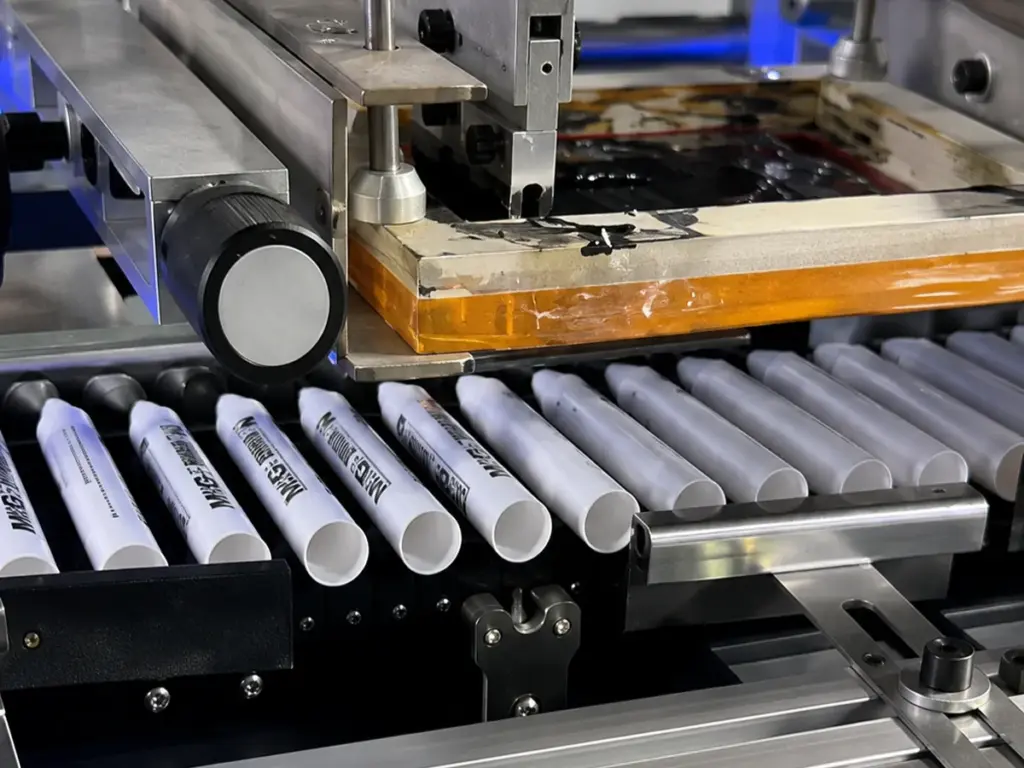
An automated screen printing line like this one earns its place on long runs of straight barrels; curved and tapered models route to the pad printing station.
How Letian Ensures Consistent Pad Printing Quality
Production runs at the company’s Wengang facility in Jiangxi—a region known as China’s pen capital—with a Guangzhou office handling export and global accounts. Ten automated and semi-automated lines cover the process, eight on parts manufacturing and two dedicated to final assembly and quality control. Pad printing sits inside that QC loop, not outside it.
Three checks apply to printed pen orders. Ink stability testing confirms the ink batch behaves before it reaches the plate. Metal parts pass 48-hour salt spray testing so clips and barrels do not corrode in transit or in a coat pocket. Ergonomic durability testing covers the finished pen under real handling, not just the imprint in isolation.
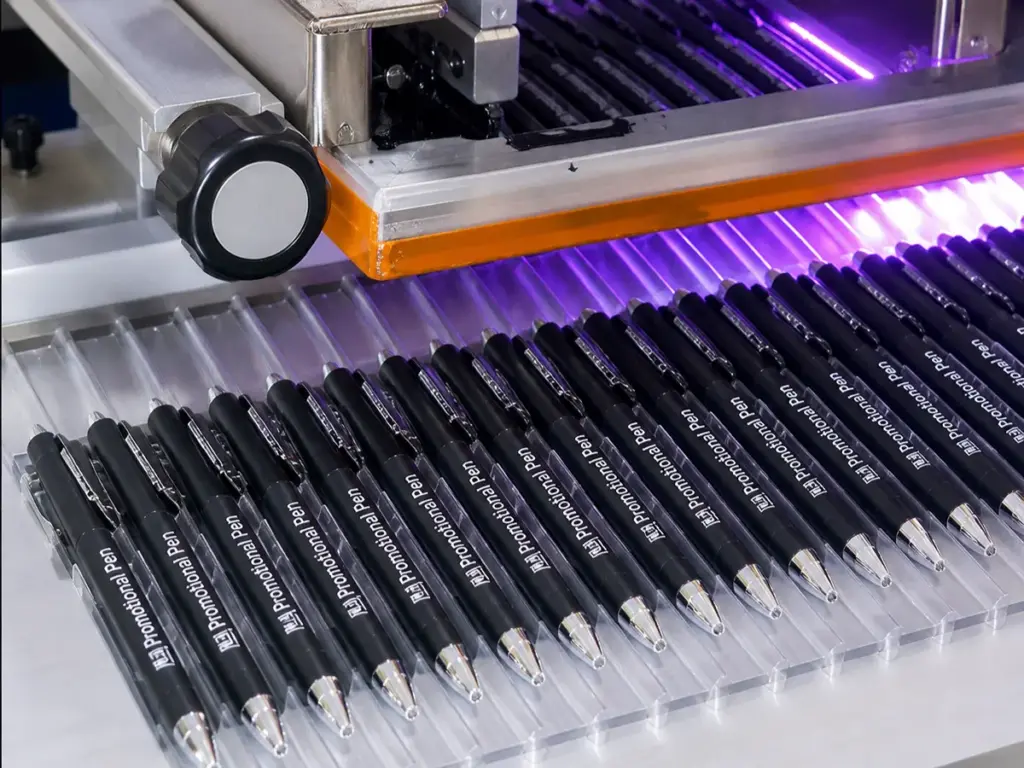
Ink curing discipline applies across every printing line at the facility, pad printing included. It is the step buyers rarely see and most often get burned by—an under-cured imprint passes the factory gate and fails in the end user’s pocket.
Certification backs the process: product certificates include SGS, MSDS, and EBO, while the factory is audited to RoHS, BSCI, and TÜV Rheinland standards. Orders start at 100 units for gift pens and sets and scale past 100,000, against annual capacity of nearly 10 million pens. Sampling takes 5–10 日, mass production 14–25 日, and quote responses go out within 6 hours with a free design mockup.
For buyers building a full custom program—barrel molds, special finishes, 梱包—the OEMおよびODMサービス team handles artwork adaptation through mass production. If you have artwork and a target quantity ready, the team at 楽天ギフト can quote the pad printing options and suggest the right ink system for your barrel material.
よくある質問
What is pad printing on pens?
Pad printing is an indirect process that uses a flexible silicone pad to transfer ink from an etched steel plate onto curved pen barrels. It is the standard method for branding plastic and metal promotional pens.
Is pad printing durable on metal pens?
はい. Once the imprint is fully cured, pad-printed ink withstands daily pocket wear. Le-tian Gifts runs ink stability tests and 48-hour salt spray tests on metal parts before shipment.
How many colors can pad printing apply?
A standard pen setup applies 1–4 spot colors. Each color needs its own etched plate and pad, so complex multi-color logos raise setup cost and registration risk.
What is the minimum order for pad printed pens?
Le-tian Gifts starts at 100 units for gift pens and pen sets, with the same printing quality standards applied from sample batches through 100,000-unit runs.
How long do sampling and production take?
Physical samples take 5–10 days after artwork approval. Mass production runs 14–25 days depending on the pen model and order size.
Pad printing or screen printing—which should I choose?
Choose pad printing for curved barrels and fine one- to four-color logos. Choose screen printing for large, solid prints on straight barrels. Most promotional pen orders fit pad printing better.