A promotional pen reaches a pocket, and a week later the logo is a scuffed outline. The ink did not fail; the printing method was wrong for the barrel. Method is the one decision on a custom pen order that the material makes for you, and getting it wrong only surfaces after the shipment lands.
Plastik, Metall, and eco-friendly barrels each take a different process. Screen printing needs a flat-ish zone, pad printing wraps a curve, laser burns metal, digital lays full color with no screen, and foil presses a metallic film. This guide matches every barrel material to the methods that actually hold, then gives the factors to weigh before a bulk order is committed.
Key Takeaways
- The material decides the method: surface energy, hardness, and heat tolerance rule processes out before brand preference enters.
- Plastic barrels: pad printing wraps curves, screen printing covers flat zones, digital adds full color with no screen.
- Metal barrels: laser engraving is permanent at 0.1mm precision; ink methods need a coated or anodized surface to bite.
- Eco barrels (bamboo, recycled, biodegradable): laser and low-heat digital win, because a hot die scorches or warps them.
- Setup cost falls as volume rises: screen and foil carry per-run tooling, laser and digital carry almost none.
- Le-tian-Geschenke: Mindestbestellmenge 100 Einheiten, sampling 5–10 Tage, mass production 14–25 Tage, quotes within 6 hours, free design mockup.
Why Choosing the Right Printing Method Matters
Adhesion is the whole game. Ink bonds to a barrel only when the surface energy of the material and the ink are compatible; miss that pairing and the print lifts, cracks, or rubs off in a pocket. A method that looks perfect on a sample board can still fail on the real material if the surface was never prepared for it.
The cheapest quote is often the one that skipped the compatibility check. Polypropylene and recycled barrels are low-surface-energy plastics: without flame or corona treatment, ink sits on the surface and flakes within days. Ask any supplier how they prepare the barrel before printing, and ask for a sample that has been handled and rubbed, not one fresh off the line.
The stakes scale with the order. On 100 pens a misprint is an annoyance; on 50,000 it is a rejected shipment and a re-run that blows the campaign date. Choosing the method against the material up front is the cheapest insurance on the entire order, and it is the first thing an experienced OEM and ODM service settles before quoting.
Best Printing Methods for Plastic Pens
Plastic is the highest-volume promotional barrel, and it forgives a lot if the process matches the shape.
- Tampondruck. The default for curved barrels: a soft silicone pad picks ink off an etched plate and conforms to the curve, printing where a flat screen cannot reach.
- Siebdruck. Best on flat or gently curved zones and larger color areas; it lays a thicker, more opaque ink film than pad, which matters on dark barrels.
- Digital (UV inkjet). Full-color artwork and gradients with no screen or plate, ideal for short runs and photographic logos.
The catch is surface energy. ABS takes ink readily, but polypropylene and recycled PET do not, and need corona or flame treatment first or the print lifts. Soft-touch coatings need an ink formulated for that coating, not a standard plastisol, or the mark peels at the edges.
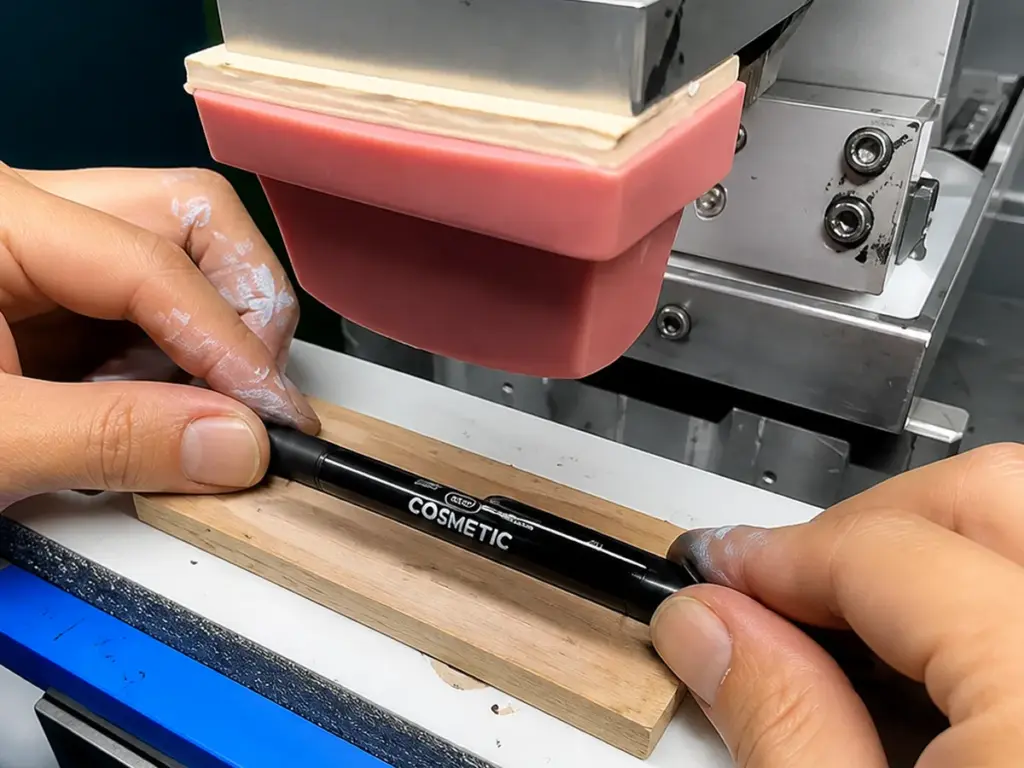
Pad printing conforms a silicone pad to a curved barrel, the reason it is the default for round plastic pens.
For most plastic promotional orders the real choice is pad versus screen: pad for a wrapped logo on a round barrel, screen for a bold flat mark or a wide print area. When the artwork is full color or the run is short, digital removes the per-color screen cost entirely, which is why it wins low-volume individuelle Stifte.
Best Printing Methods for Metal Pens
Metal is where permanence lives, and where a wrong method is most obvious. The deeper question of whether to choose metal at all is covered in the metal pen vs plastic pen comparison; here the concern is only how the mark holds.
- Lasergravur. Burns the mark into the surface, permanent as the barrel itself. On anodized aluminum it removes the dye layer to reveal bright metal; on coated metal it exposes the base tone. Runs at 0.1mm precision for fine text and small logos.
- Screen or pad printing. Works only where the ink can bite: a coated, lacquered, or anodized barrel. On bare polished metal, ink sits on top and wears within weeks.
- Hot foil stamping. Presses a metallic film onto a coated barrel for a premium gold or silver mark, but it is a surface layer, not an engraving.
Bare stainless and uncoated aluminum reject ink; the only durable mark is laser or a chemical etch. If a supplier promises full-color ink on raw polished metal with no coating, the print will not survive a week of handling. Metal parts also face corrosion, so a 48-hour salt spray test on the finished part is a reasonable ask before a large order.
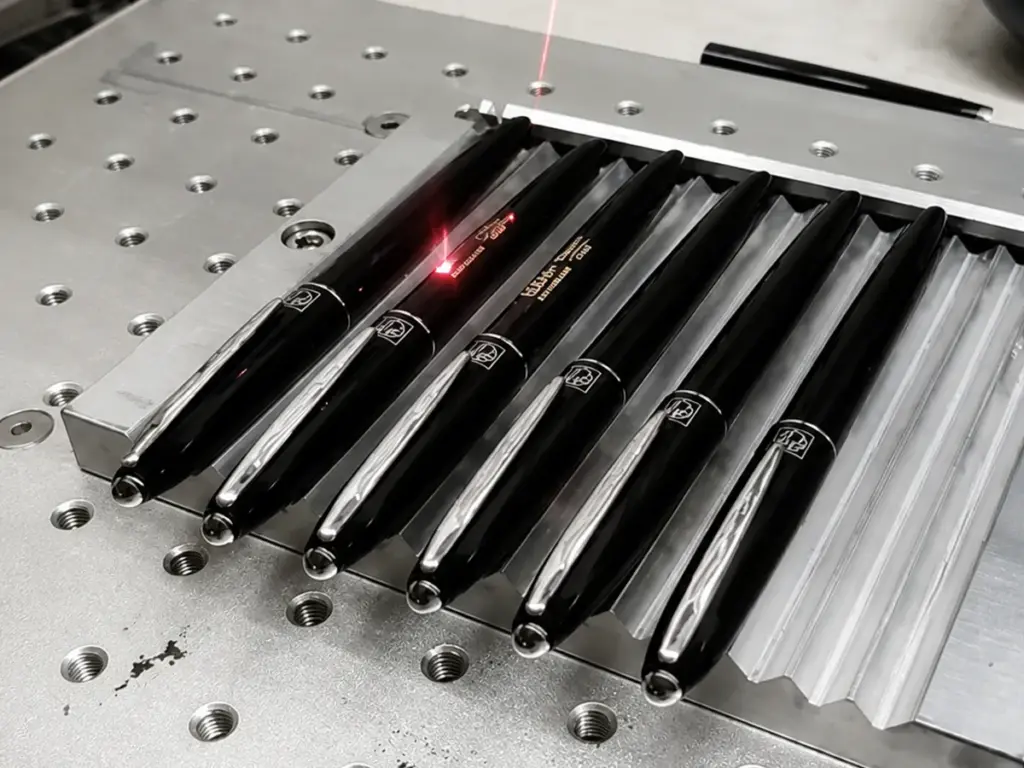
Laser engraving burns a permanent mark into metal, the only decoration that outlasts the barrel itself.
Best Printing Methods for Eco-Friendly Pens
Eco barrels behave like their material, not like a standard pen. Bamboo, wood, recycled plastic, wheat-straw PLA, and biodegradable composites each react to heat and ink differently.
- Bamboo and wood. Laser engraving is the cleanest mark, burning the logo in with no ink, no consumable, and no chemical. It reads as natural, which is the whole point of the material.
- Recycelter Kunststoff (rPET, reclaimed PP). Pad or screen printing, but only after surface treatment, since recycled resin is low-energy and batch-inconsistent.
- Biodegradable and PLA composites. Low-heat processes only. A hot foil die or a high-heat cure can warp or scorch the barrel, so direct-to-object digital is often the only safe full-color option.
Heat is the enemy of every eco barrel. Foil stamping presses a heated die and can scorch bamboo or soften a PLA blend, so reserve foil for the recycled-metal or coated barrels that tolerate it. Ask whether the ink is compatible with a compostable substrate and whether it affects the barrel certification.
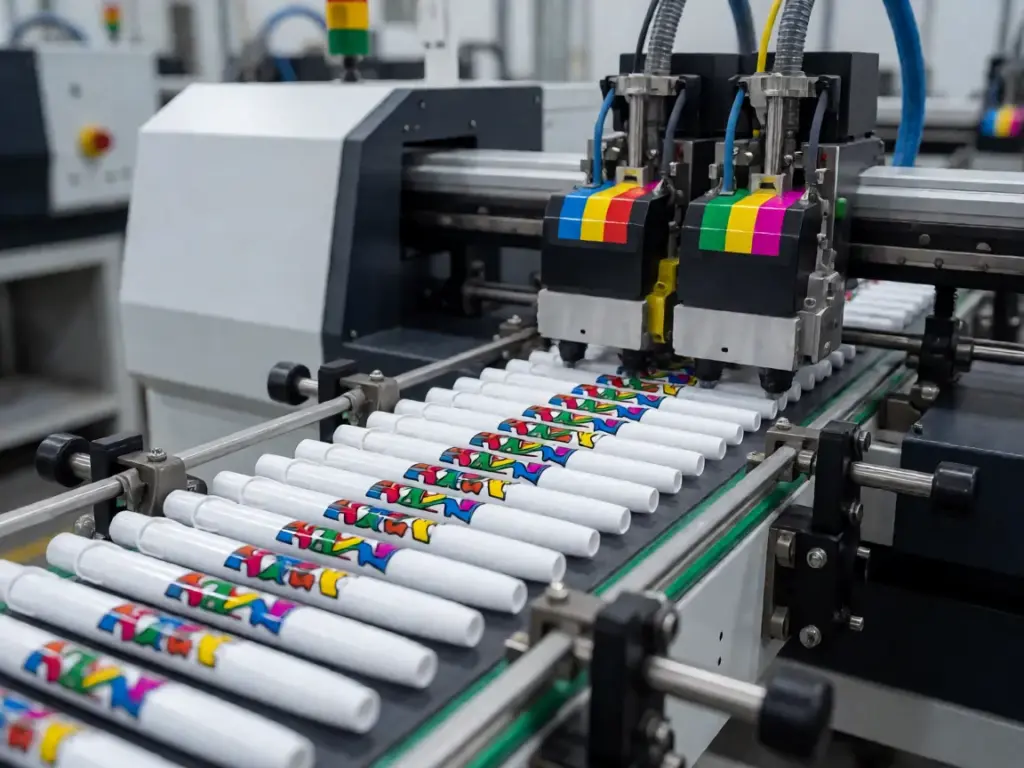
Digital UV printing lays full-color art with no screen and minimal heat, one of the few options a heat-sensitive biodegradable barrel can take.
The eco story also has to survive the compliance check. A biodegradable pen printed with a non-compliant ink undermines the claim, so the ink and its certification matter as much as the substrate itself.
Matching a Method to Your Barrel?
Send the barrel model and your artwork for a free design mockup and a process recommendation with your quote. No guesswork on adhesion, Farbe, or setup cost.
Mindestbestellmenge 100 | Free mockup| Quotes in 6 hours
Explore Our Products →Comparison of Pen Printing Methods by Material
One matrix settles most of the decision. Read the barrel material across, and the viable methods narrow to two or three before price ever enters.
| Material | Best Method | Warum es funktioniert | Watch-Out |
|---|---|---|---|
| ABS / hard plastic | Pad or screen | Ink bonds with no treatment | Deep curves favor pad |
| PP / recycled plastic | Pad or screen, treated | Corona or flame lifts surface energy | Untreated, ink flakes in days |
| Coated / lacquered metal | Screen, pad, or foil | The coating gives ink a bite | A scratch exposes bare metal |
| Anodized aluminum | Lasergravur | Removes dye, reveals bright metal | Ink will not bond to anodizing |
| Bamboo / wood | Lasergravur | No ink, a natural burnt mark | A hot foil die scorches the grain |
| Biodegradable / PLA | Low-heat digital | Runs cool and needs no screen | A hot die or cure warps it |
The pattern is consistent: soft, natural, and heat-sensitive barrels push toward laser and low-heat digital, while hard, coated, and treated barrels open up pad, screen, and foil. Where one model mixes materials, such as a metal cap on a recycled barrel, the program may need two processes, which is a coordination question rather than a quality one. The complete set of options sits in the pen printing methods Führung.
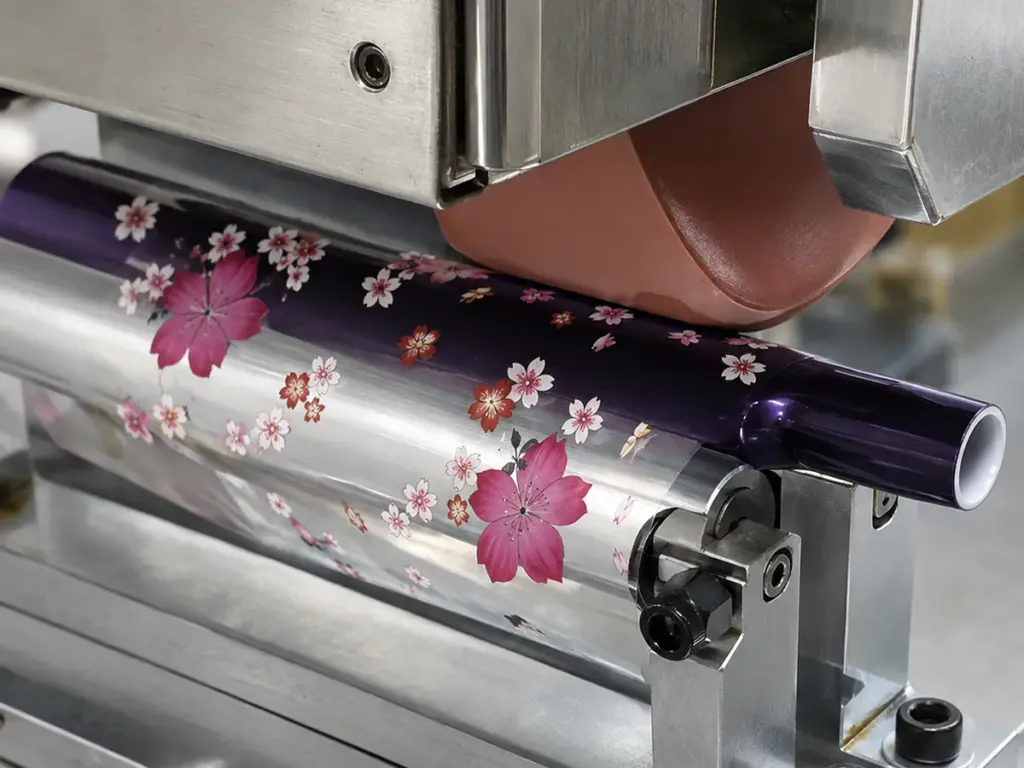
Hot foil stamping presses a metallic film onto a coated barrel: premium, but it carries a one-time die cost and a heat the eco barrels cannot take.
Factors to Consider Before Choosing a Printing Method
Material narrows the field; these factors pick the winner inside it. Weigh them in roughly this order, because the first two can disqualify a method outright.
- Color count. One or two spot colors suit screen and pad; full color or a gradient needs digital, since screen charges a separate setup for every color.
- Durability and lifespan. A pen meant to last years wants laser on metal; a single-event giveaway tolerates pad-printed ink.
- Order volume. High volume amortizes screen and foil tooling, while low volume favors laser and digital, which carry almost no setup.
- Budget and setup. Foil and screen have upfront tooling (a die, a screen per color); laser and digital run file-to-barrel with no tool. The trade-off is detailed in the custom pen cost breakdown.
- Einhaltung. Ink on a food-contact, toy, or eco claim must meet RoHS and REACH, so confirm the ink, not just the barrel.
- Turnaround. Sample-first is non-negotiable on a new material, and the method that proofs fastest wins a tight campaign date.
| Method | Best On | Color Capability | Setup Cost |
|---|---|---|---|
| Tampondruck | Curved plastic | 1–4 spot colors | Niedrig: one etched plate |
| Siebdruck | Flat plastic, coated metal | 1–6 spot colors, opaque | Per color: one screen each |
| Lasergravur | Metall, bamboo, wood | Material tone only, 0.1mm fine | None: file to barrel |
| Digital (UV) | Most barrels, heat-sensitive | Full color and gradients | None: file to barrel |
| Hot foil | Coated flat barrels | Metallic and pigment | One die per artwork |
| Sublimation | Polymer-coated light barrels | Full color, dye in coating | Per design transfer |
Sublimation deserves a note. It needs a polymer-coated barrel and works by turning dye into a gas that bonds into the coating, so it is limited to light-colored, coated pens. The full process and its limits are covered in the guide to sublimation pens.
Why Work with an Experienced Custom Pen Manufacturer
A method is only as good as the shop that runs it against your specific barrel. Experience shows up in the questions a supplier asks before quoting: what is the barrel material, is it coated, how many colors, what volume, and does it carry an eco or compliance claim. A supplier who quotes without asking is guessing with your budget.
Le-tian Gifts has made pens since the mid-1990s and registered in 2010, and ranks among the top three makers in China’s gift pen industry. Production runs from Wengang in Jiangxi, the country’s pen capital, on ten automated and semi-automated lines (eight for parts, two for assembly and quality control), with annual capacity near 10 million pens and a Guangzhou export headquarters. The precision customization center handles 0.1mm laser engraving, Siebdruck, and precise VI color matching in-house, and a ten-person R&D team releases more than 110 new designs a year.
Quality is verified in a dedicated QC center with ink stability testing, 48-hour salt spray tests on metal parts, and ergonomic durability testing. Product certificates cover SGS, Sicherheitsdatenblatt, and EBO, and the factory is audited to RoHS, BSCI, and TÜV Rheinland standards, the compliance backbone behind clients such as Google, DHL, BMW, and Samsung.
The order frame is fixed: quotes within 6 hours, a free design mockup with your inquiry, sampling in 5–10 Tage, mass production in 14–25 Tage, and a 100-unit minimum that scales to runs past 100,000. Bring the barrel model and artwork to Le-tian-Geschenke; the mockup and a process recommendation arrive with the quote, so the method is chosen against a proof of your actual pen rather than a stock photo.
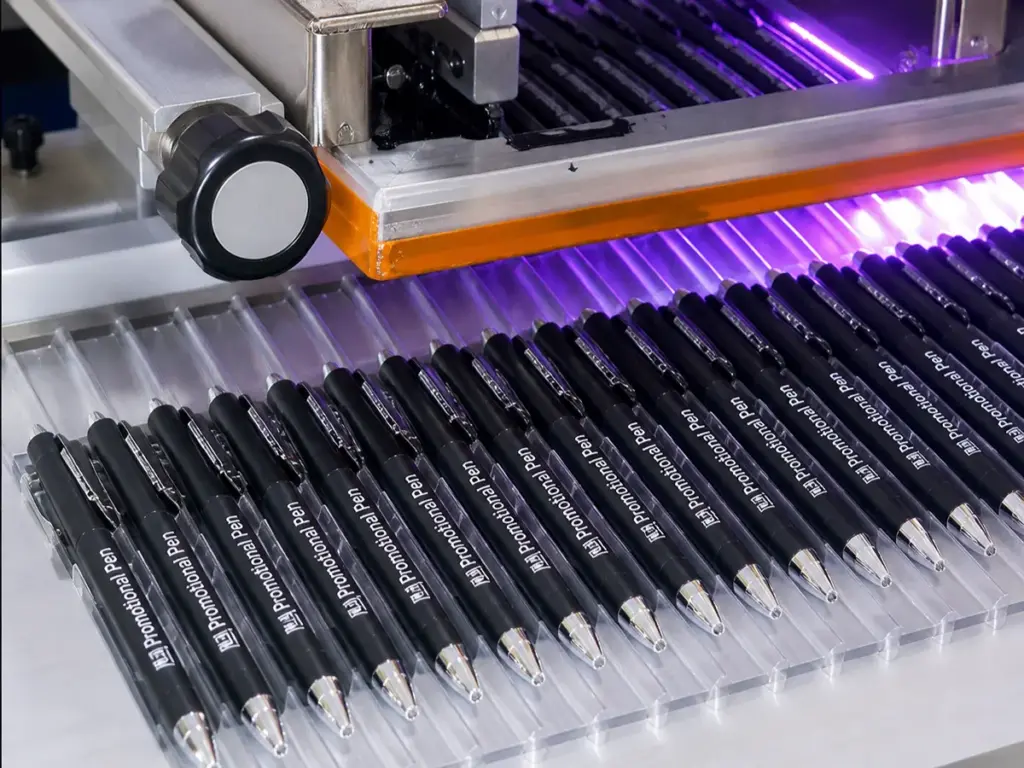
Each printed color cures before the next is applied, so the mark bonds to the barrel rather than smearing.
Häufig gestellte Fragen
What is the best printing method for plastic pens?
Pad printing for curved barrels, screen printing for flat zones and bold color, and digital UV for full-color or short runs. The barrel shape and the artwork decide among the three.
What is the best printing method for metal pens?
Lasergravur, because it burns a permanent mark into the metal at 0.1mm precision. Ink methods need a coated or anodized surface to hold.
Which printing method lasts the longest?
Laser engraving on metal is permanent, since it removes material rather than adding a layer. Foil and ink are surface layers that can wear over years of handling.
Can eco-friendly pens be printed?
Ja. Bamboo and wood take laser engraving with no ink, recycled plastic needs treated pad or screen printing, and biodegradable barrels need low-heat digital to avoid warping.
Does the printing method affect cost?
Setup does. Screen and foil carry per-run tooling (a screen per color, a die per artwork), while laser and digital are file-to-barrel with almost no setup, so they win short runs.
What are the MOQ and lead times at Le-tian Gifts?
Orders start at 100 Einheiten. Sampling takes 5–10 days after artwork approval and mass production runs 14–25 Tage, with quotes returned within 6 hours.