A gift box opens on a matte black pen, and the logo catches the light in brushed gold. That shimmer is not ink and not paint: it is a metallic layer, microns thin, pressed into the barrel by a heated die. Foil printing produces a finish no liquid ink matches, which is why premium pen programs keep reaching for it.
This guide breaks down the process, the foil types, which barrels take it well, and where it loses to laser engraving. The specs that follow are the ones that decide whether an order stamps sharp or comes back with fuzzy edges.
Key Takeaways
- Foil printing (hot stamping) presses a heated die against a thin foil film, transferring a solid metallic or pigmented layer to the barrel.
- The metallic shine comes from a vacuum-deposited aluminum layer inside the film, not from ink.
- One die per artwork: engraved once, reused across repeat orders.
- Gold and silver are the classics; pigmented and holographic foils cover brand colors.
- حاد, simple logos stamp best; hairlines and gradients do not transfer cleanly.
- موك 100 units at Le-tian Gifts; sampling 5–10 days, mass production 14–25 days.
What Is Foil Printing?
Foil printing, more precisely hot foil stamping, transfers a dry pigment or metallic layer onto the pen surface with heat and pressure—no liquid ink is involved. The foil film carries four layers: a PET carrier, a release coat, the color or metalized layer, and a heat-activated adhesive. When the die strikes, the adhesive bonds that thin layer to the barrel and the carrier pulls away clean.
The physics is the same as book cover stamping and wine label finishing, run at pen scale. On pens, the die is engraved from brass, copper, or magnesium to match the logo exactly, and the barrel sits in a cradle that rotates it under the die.
One confusion to clear at quote stage: metallic pad printing is not foil. That process pushes a silver-tinted ink through an etched plate onto the barrel, and it dries to a soft grey sheen rather than a mirror. Real foil lays down a metalized film, so the reflectivity is physical, not pigment. If a sample looks bright under a lamp but flat in daylight, it is ink, and it will not read as premium on a gift-box pen.
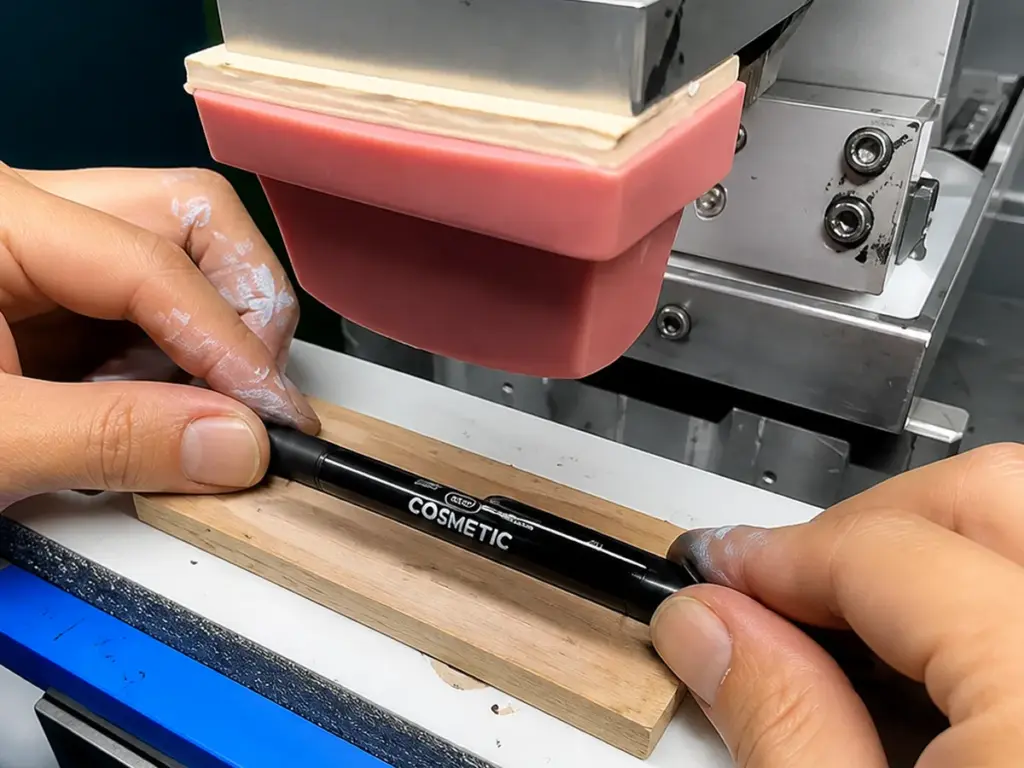
Pad printing lays metallic ink on a curved barrel: the soft-sheen alternative buyers often mistake for true foil.
How Foil Printing Works on Custom Pens
Four stages take artwork from file to finished barrel:
- Die making. The logo is engraved into a metal die, reversed like a stamp; one die per artwork, stored for re-orders.
- Fixturing. Pens load into cradles that present the print zone to the die at a fixed angle.
- Stamping. The heated die presses the foil film onto the barrel for a fraction of a second; heat activates the adhesive, pressure transfers the layer.
- Inspection. The transfer sets as the adhesive cools; the foil edge is the first place quality shows up or fails.
Temperature, pressure, and dwell time form the stamping triangle. Too cool and the layer lifts at the edges; too hot and it spreads past the logo boundary, a defect visible only in raking light. The window is narrow enough that foil runs are approved sample-first, never straight from the file.
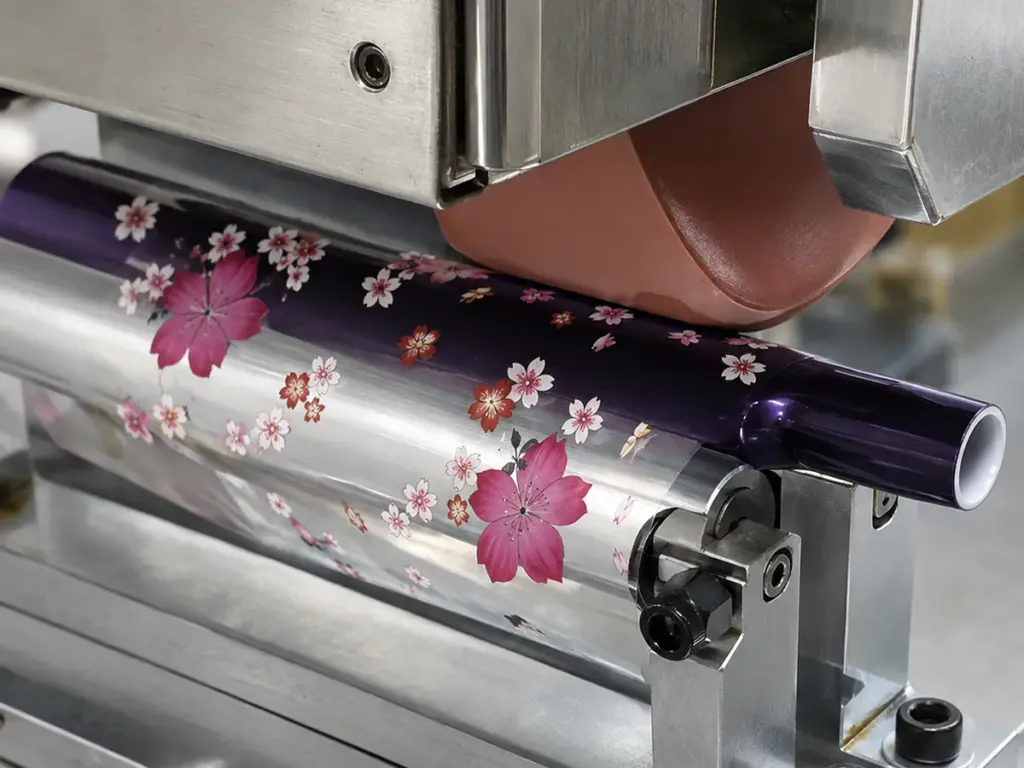
Hot stamping machine applying a patterned foil transfer to a cylindrical barrel.
Die material tracks run length. Magnesium engraves fast and cheap, which suits prototypes and short runs; brass and copper cost more but survive long production and repeated heat cycles, so a re-order program amortizes them across the units that follow. The die is a one-time tooling cost, and its material is chosen against the volume the order will actually reach, not against the first sample.
Benefits of Foil Printing
Four benefits explain why foil sits at the top of the premium stack:
- Real metallic reflectivity. The aluminum layer bounces light the way a polished edge does; ink prints flat by comparison.
- ينظف, dry process. No solvents and no drying tunnels: the transfer completes at the strike.
- Crisp edges on simple marks. Solid areas stamp with a sharp boundary that spot-color processes struggle to hold.
- Re-order stability. The stored die reproduces the original run exactly on repeat orders.
For brand programs the value is positional: foil marks the pen as a gift, not a giveaway. Buyers notice the finish before they read the logo, which is exactly what a premium program wants.
The cost structure is the flip side of that positioning. Foil carries no per-color setup the way screen printing does, because the film supplies the color and one die covers the whole mark; a two-tone gold logo stamps for the same tooling as a one-color mark. What it does carry is the die itself, a fixed upfront cost that only clears once volume rises. That is why foil earns its keep on premium runs and struggles on cheap, high-mix giveaways.
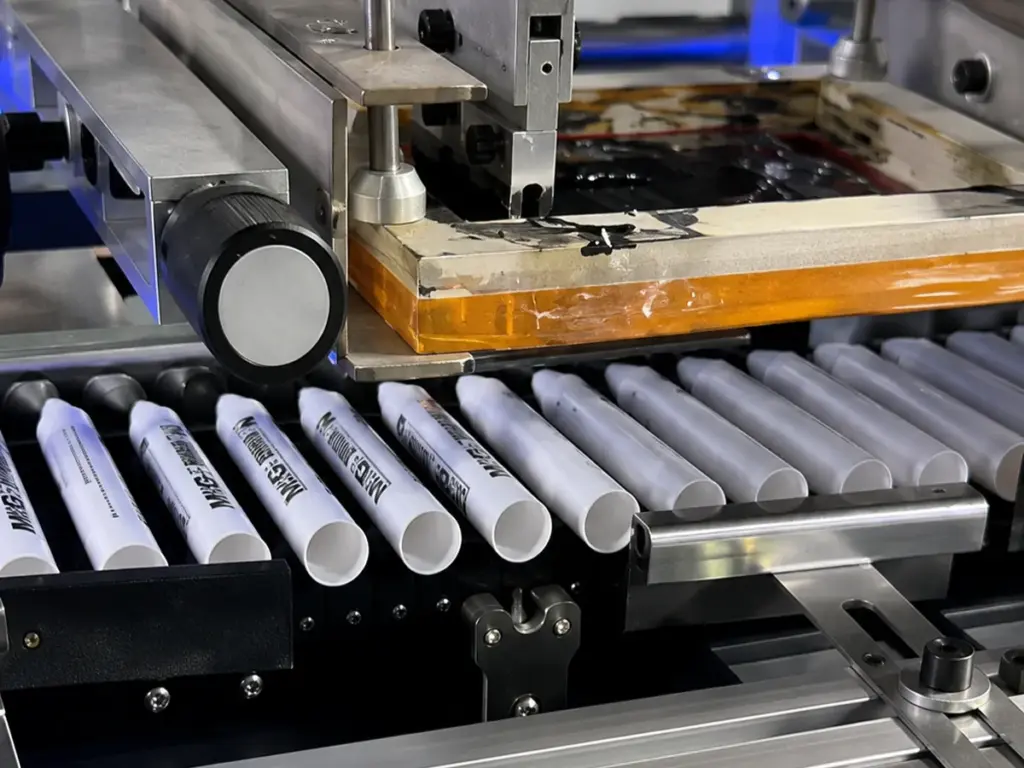
Screen printing charges a separate setup for every color; foil supplies all tones from one die and one film.
Gold Foil vs Silver Foil vs Colored Foil
The foil choice is a brand decision, not a decoration decision:
| Foil Type | Look | Best Use |
|---|---|---|
| Gold | Warm, classic prestige | Awards, executive gifts, anniversary editions |
| Silver | Cool, modern hardware tone | Tech brands, corporate sets, neutral palettes |
| Colored pigment | Solid brand hue, matte or gloss | Matching a locked brand color on dark barrels |
| Holographic | Iridescent, angle-shifting | Anti-counterfeit marks, youth and entertainment brands |
If the brand palette is locked to a code and the program reads corporate, silver or a matched pigment keeps the pen inside the identity system. Gold is the loudest of the four: it sells prestige, not restraint. Pick the foil the brand would wear, not the one that photographs best on a sample board.
Color is only half the decision; finish is the other half. The same gold comes in high gloss, matte, and brushed-metal textures, and patterned foils add a linen or diffraction effect that shifts under light. A matte gold on a soft-touch barrel reads understated, while a gloss gold on lacquer reads loud. Match the finish to the coating as deliberately as the hue to the brand book, and prove it on a stamped sample before the run.
Which Pens Are Suitable for Foil Printing?
- Flat and gently curved barrels. The die is flat, so the contact band must stay flat; straight zones stamp clean.
- Coated and lacquered surfaces. Painted metal and soft-touch coatings take the heat-activated adhesive best.
- Dark barrels. Gold and silver read hardest against black, navy, or deep green.
- Wide print bands. Narrow barrels leave no room for the die to seat without edge lift.
What does not stamp cleanly: deep curves near the clip, knurled or textured grips, and hairline detail. The adhesive needs a continuous contact band, and texture breaks it into islands that flake. The barrel question behind this choice is covered in the metal pen vs plastic pen comparison.
Material also sets the temperature ceiling. Lacquered metal and anodized aluminum take the heat and hold the adhesive best. Bare ABS plastic is the risk case: too much dwell softens the barrel, so plastic runs use lower temperature and lighter pressure, and the sample has to prove the surface does not dimple or bloom. Soft-touch coatings sit in between and lean almost entirely on the adhesive, which is why they are always approved sample-first.
Foil Printing vs Laser Engraving
Two premium finishes, opposite physics: foil adds a layer, laser removes material.
| Aspect | Foil Printing | النقش بالليزر |
|---|---|---|
| Mark type | Transferred film layer | Material burned away |
| Color | Gold, فضي, pigment, holographic | Material tone only, mono |
| متانة | Resists daily handling; edges can wear over years | Permanent as the barrel itself |
| Detail | Solid areas and simple marks | Fine lines and small text at 0.1mm precision |
| Best on | Coated, flat-to-gently-curved barrels | Metal and anodized barrels |
| Re-orders | Stored die reused | Digital file reused |
The economics differ too. Foil needs a die engraved before the first unit, a fixed tooling cost that lands hardest on short runs; laser needs no die, only a file, so it starts cheaper at low volume but can run slower per part on long production. Neither is cheaper in the abstract: the crossover is the order quantity, which is why the quote should arrive with a process recommendation rather than a default.
Choose foil when color and sheen carry the brand; choose laser when the mark must outlive the pen. Premium programs often run both on one model: foil on the cap band, laser on the barrel. Both sit inside the wider set of pen printing methods. Where a program wants the mark to last as long as the pen, laser engraving at 0.1mm precision is the in-house option at Le-tian Gifts, routed through the same خدمات صانعي القطع الأصلية وأوديإم workflow that carries the quote, mockup, and sample.
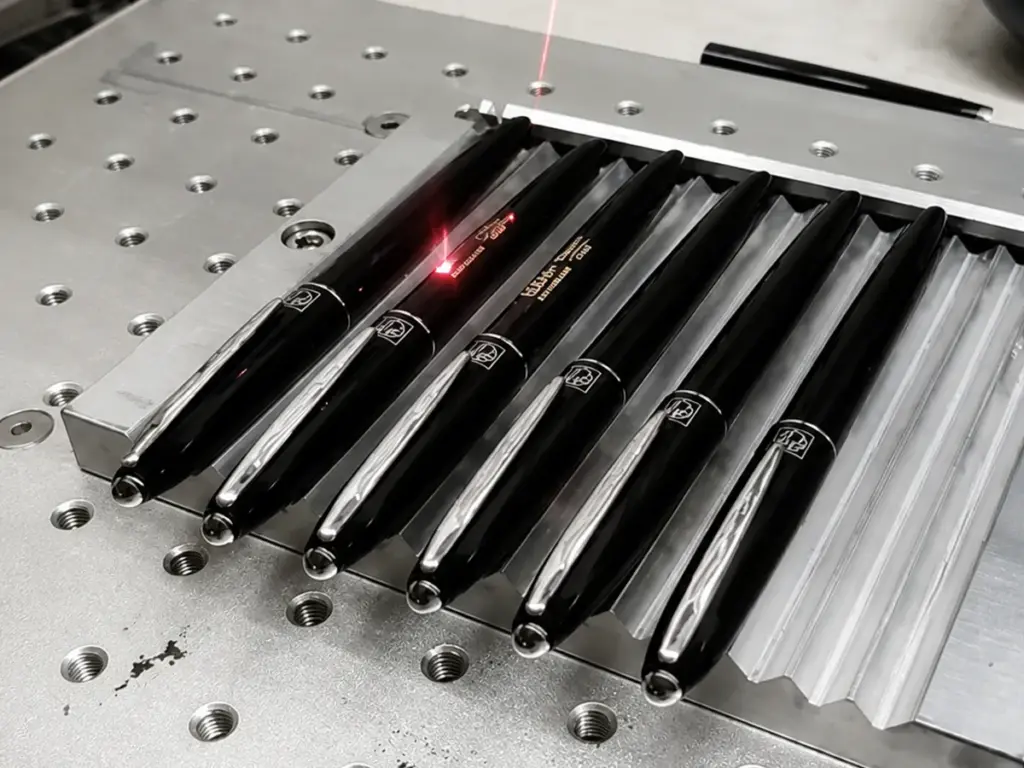
Laser engraving burning a mark into metal: the permanent alternative to a foil layer.
Popular Uses for Foil Printed Pens
- Executive and boardroom gifts. Gold or silver on a lacquered barrel reads as hardware, not stationery.
- Award and recognition programs. The finish signals the occasion before any engraving explains it.
- Premium retail sets. Foil-stamped pens paired with boxes, where shelf appeal decides the sale.
- Anniversary and limited editions. Holographic or pigment foils mark the edition without a custom ink run.
- Signing and ceremony keepsakes. Notary closings and contract signings hand over a foil-stamped pen as the record of the moment.
- Wedding and event favors. Gold or rose foil personalizes a date on a slim barrel without a full-color print run.
These are catalog plays as much as decoration plays: browse the أقلام مخصصة range and shortlist models with a flat, wide print band before the artwork is even drawn.
Specifying a Foil or Laser Premium Run?
Send your artwork and barrel model for a free design mockup and a process recommendation with your quote.
موك 100 | Free mockup| Quotes in 6 hours
Explore Our Products →Quality Checks and Specifications for Foil Pen Orders
Foil quality is verified before the run, not after: a die check, a stamped sample on the actual barrel, and an edge-lift inspection under raking light. Ask the supplier for that stamped sample rotated under light, the same way a screen printer shows a registration proof.
في هدايا لو تيان, the order frame around that sample is fixed: quotes within 6 hours, a free design mockup with your inquiry, sampling in 5–10 days after artwork approval, mass production in 14–25 days, minimum order 100 وحدات. The QC process includes ink stability testing and 48-hour salt spray tests on metal parts, and metal marking runs at 0.1mm precision in the precision customization center.
Production sits at the Wengang, Jiangxi facility—China’s pen capital—on ten automated and semi-automated lines with annual capacity near 10 million pens. Product certificates include SGS, صحيفة بيانات سلامة المواد, and EBO; the factory is audited to RoHS, بسي, and TÜV Rheinland standards. Bring the artwork and barrel model to هدايا لو تيان: the free mockup shows how the mark reads on the actual barrel, and the quote carries a process recommendation, so the finish is decided against a proof rather than a file.
الأسئلة المتداولة
What is foil printing on pens?
Hot foil stamping: a heated engraved die presses a thin foil film onto the barrel, transferring a solid metallic or pigmented layer with no liquid ink.
Is foil printing durable?
It resists daily handling, but it is a surface layer, so edges can wear over years of use. Laser engraving is the permanent alternative on metal.
Which foil colors are available?
Gold and silver are the classics; pigmented foils match a locked brand color, and holographic foils shift with the viewing angle.
Can foil printing handle detailed logos?
Solid areas and simple marks stamp crisply. Hairlines, gradients, and fine text do not transfer cleanly through a die.
Foil printing or laser engraving, which is better?
Foil for color and sheen on coated barrels; laser for permanence on metal. The brand brief decides, not a quality ranking.
What are the MOQ and lead times?
Orders start at 100 وحدات. Sampling takes 5–10 days after artwork approval; mass production runs 14–25 days.